
Description
Calibration Data Management
1. Introduction
Calibration data management refers to the systematic collection, processing, storage, and traceability control of measurement data generated during flow meter calibration. In industrial flow measurement, calibration is not a one-time event but a continuous process that produces large volumes of numerical results, including flow rate readings, reference values, temperature and pressure records, and uncertainty calculations.
Without structured calibration data management, laboratories and manufacturers face difficulties in maintaining traceability, verifying long-term measurement stability, and generating consistent calibration certificates. Poor data handling can lead to lost historical records, inconsistent reporting formats, and reduced confidence in measurement results.
For flow meter manufacturers, calibration laboratories, and industrial users, effective calibration data management directly supports measurement reliability, regulatory compliance, and quality assurance across the full lifecycle of a flow meter.
2. What Is Calibration Data Management?
Calibration data management is the process of acquiring, recording, processing, and archiving measurement data generated by a flow calibration system during the verification of flow meters.
Its main purpose is to:
- Ensure calibration results are accurately recorded and stored
- Support traceability between measured values and reference standards
- Provide consistent, reproducible calibration reports
- Enable long-term tracking of instrument performance
Calibration data management is closely linked to flow measurement accuracy. If calibration data is incomplete, inconsistent, or improperly processed, the resulting uncertainty values and pass/fail determinations for a flow meter cannot be considered reliable. In this sense, data management functions as a technical bridge between raw measurement signals and a valid, traceable calibration outcome.
3. Working Principle and System Structure
A flow calibration system generates a known reference flow condition and compares it with the output of the flow meter under test. Calibration data management operates as an integrated function within this system, capturing and processing information at each stage of the measurement process.
Main components involved in calibration data management include:
- Reference standard – Provides the traceable reference value (e.g., mass, volume, or master meter reading) against which the tested flow meter is compared.
- Flow generation system – Produces stable, controllable flow conditions required for the calibration process.
- Measurement section – Where the device under test is installed and its output signal is recorded.
- Data acquisition system – Collects raw signals (flow rate, temperature, pressure, time) from both the reference standard and the tested instrument.
- Control system – Coordinates flow generation, measurement timing, and data acquisition, typically based on PLC and industrial PC automation architecture.
During calibration, the data acquisition system continuously records reference and test values. The control system synchronizes these measurements, and the resulting data set is processed to calculate deviation, repeatability, and measurement uncertainty. Digital record keeping ensures that each calibration run is stored with a unique identifier, and automated report generation compiles the processed results into a standardized calibration certificate or report.
This structured workflow reduces manual data entry errors and supports consistent documentation across multiple calibration cycles.
4. Calibration Methods and Technologies
Different calibration methods generate different types of data, and calibration data management systems must be capable of processing information from each method accurately.
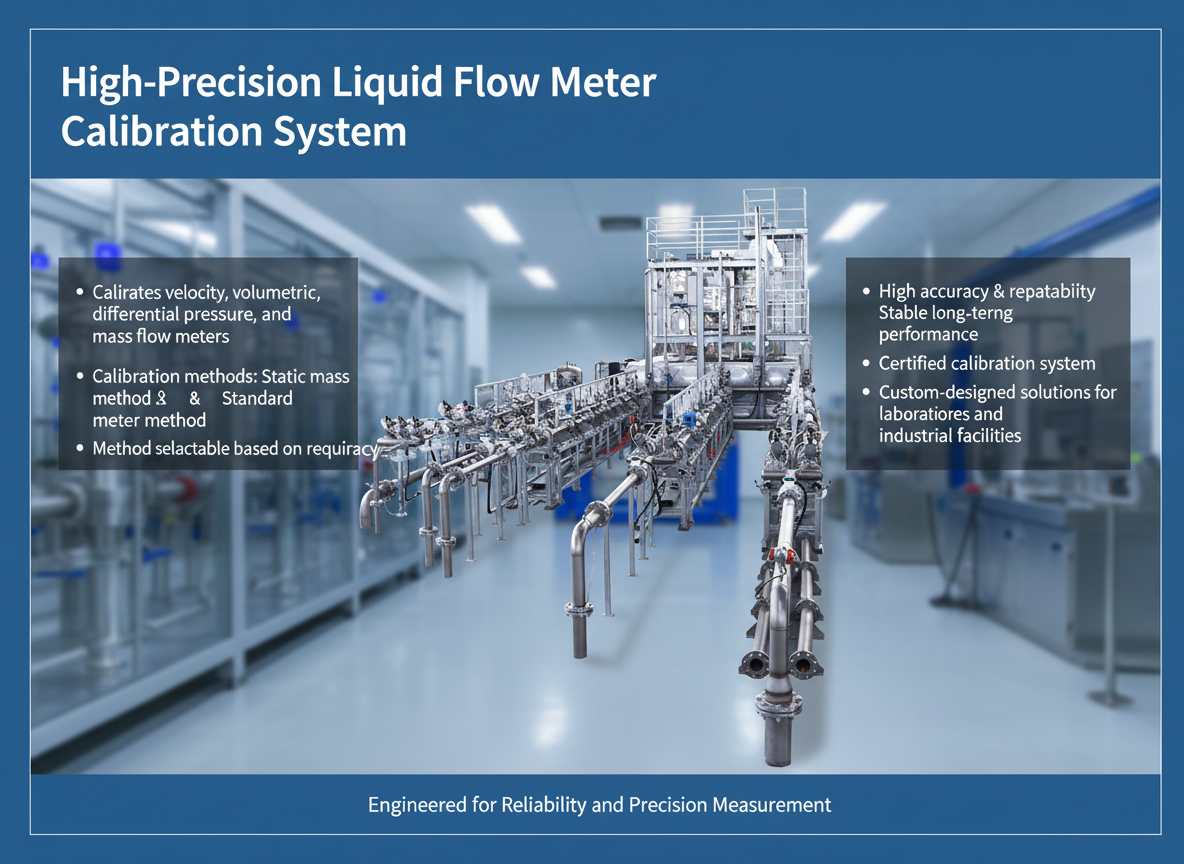
Static Mass Method
Working principle: The static mass method determines flow by diverting flow into a weighing tank over a controlled time interval and measuring the collected mass. The measured mass, combined with fluid density and elapsed time, is used to calculate the actual flow rate, which is then compared to the reading from the tested flow meter.
Advantages: High measurement accuracy, with typical uncertainty of up to 0.05% under laboratory conditions.
Suitable applications: High-accuracy calibration of liquid flow meters, particularly where low uncertainty is required for reference-grade verification.
Master Meter Method
Working principle: A previously calibrated master meter is installed in series with the flow meter under test. Both meters measure the same flow simultaneously, and their readings are compared to determine the deviation of the tested meter.
Advantages: Faster calibration cycle, suitable for continuous or in-line calibration processes; typical uncertainty of up to 0.2%.
Suitable applications: Routine calibration, field verification, and situations where rapid throughput is prioritized over the highest achievable accuracy.
In both methods, calibration data management systems are responsible for logging reference and test values, calculating deviation percentages, and generating uncertainty statements that comply with internal quality procedures.
5. How to Select a Liquid Flow Calibration System
Selecting a calibration system with appropriate data management capability requires evaluation of several engineering factors:
- Flow range – The system must cover the minimum and maximum flow rates of the instruments to be calibrated.
- Pipe diameter – Calibration systems should accommodate the diameter range of the flow meters under test, from small-bore to large-diameter configurations.
- Accuracy requirement – Determine whether high-precision reference calibration (static mass method) or faster routine calibration (master meter method) is required.
- Calibration object – Identify whether the system will be used for electromagnetic, turbine, vortex, or other flow meter types, as this affects installation and data recording requirements.
- Measurement uncertainty – Confirm that the calibration system’s uncertainty is sufficiently lower than the required accuracy of the meters being tested.
- Installation requirements – Consider available space, piping configuration, and environmental conditions such as temperature stability.
- Automation requirements – Assess whether PLC and industrial PC-based automation, automated data acquisition, and automated report generation are needed to support laboratory throughput and traceability needs.
A calibration system that integrates strong data management functions reduces manual workload and improves consistency across repeated calibration cycles.
6. Application Scenarios
Flow calibration systems with structured data management capability are used across several industrial and laboratory contexts:
- Flow meter manufacturers – Use calibration systems for factory-level verification of newly produced flow meters before shipment, requiring consistent digital record keeping for quality control.
- Calibration laboratories – Rely on structured data management to maintain traceable calibration records and issue standardized calibration certificates.
- Industrial measurement laboratories – Use calibration data to verify the ongoing accuracy of process instrumentation used in production environments.
- Water treatment industry – Requires periodic verification of flow meters used in water supply and distribution systems, where calibration records support regulatory and operational documentation.
7. Technical Parameters and Performance Considerations
Key technical parameters relevant to calibration data management and flow calibration system performance include:
- Flow range – Calibration systems can be configured to cover a wide span of flow rates depending on the reference method and system design.
- Pipe diameter coverage – Gas flow calibration systems using the sonic nozzle method can accommodate flowmeter diameters ranging from DN6 to DN1500, depending on system configuration.
- Accuracy – Static mass method calibration can achieve uncertainty as low as 0.05% under typical laboratory conditions; master meter method calibration typically achieves uncertainty up to 0.2%.
- Stability – Flow generation systems must maintain stable flow conditions throughout the measurement interval to ensure valid data collection.
- Calibration uncertainty – Total system uncertainty depends on the reference method, environmental control, and data processing accuracy.
- Data traceability – Digital record keeping ensures each calibration event can be traced back to specific reference values and test conditions.
These parameters should be verified against the specific calibration system configuration and the requirements of the flow meters being tested.
8. Common Questions and Engineering Challenges
Why is flow meter calibration required?
Flow meters can drift from their original accuracy over time due to wear, fouling, or changes in fluid properties. Calibration verifies whether the instrument still meets its specified accuracy class.
How often should flow meters be calibrated?
Calibration intervals depend on application criticality, regulatory requirements, and manufacturer recommendations. Industrial users typically establish periodic calibration schedules based on operational risk and historical drift data.
What affects calibration accuracy?
Factors include flow stability, temperature and pressure fluctuations, air entrainment in liquid systems, installation conditions, and the accuracy of the reference standard itself.
What calibration method should be selected?
The static mass method is preferred when the highest accuracy is required. The master meter method is suitable for faster, routine calibration where slightly higher uncertainty is acceptable.
What are the main challenges in calibration data management?
Common challenges include maintaining consistent data formats across multiple calibration runs, ensuring accurate synchronization between reference and test signals, and preserving long-term traceability of historical calibration records. Automated data acquisition and digital record keeping help address these challenges by reducing manual data handling and standardizing report generation.
9. How to Select a Reliable Calibration System Manufacturer
When evaluating a calibration system manufacturer, industrial buyers should consider:
- Manufacturing capability – Ability to produce both flow meters and calibration systems, indicating a broader understanding of measurement technology.
- Calibration technology – Availability of multiple calibration methods, such as static mass and master meter techniques, to match different accuracy requirements.
- Quality control – Adherence to recognized quality management systems and documented manufacturing processes.
- Engineering experience – Demonstrated experience in designing calibration systems for varied flow ranges and pipe diameters.
- Customization capability – Capability to adapt system configuration, automation level, and data management features to specific laboratory or factory requirements.
- Technical support – Availability of installation guidance, commissioning support, and after-sales technical assistance.
- Export capability – Experience supplying calibration equipment to international markets, reflecting familiarity with varied technical requirements.
10. About Kaifeng Xinya Instrument Co., Ltd.
Kaifeng Xinya Instrument Co., Ltd., established in 2004 and headquartered in Kaifeng, Henan, China, is an industrial instrumentation manufacturer specializing in flow measurement technology and flow calibration system design and production.
The company manufactures a range of flow meters, including electromagnetic, turbine, vortex, and Coriolis mass flowmeters, alongside liquid flow calibration systems based on the static mass method and master meter method, as well as gas flow calibration systems using the sonic nozzle method.
Kaifeng Xinya Instrument integrates PLC and industrial PC-based automation for calibration data acquisition, processing, and digital record keeping, supporting automated report generation for traceable calibration results. The company holds ISO 9001:2015, ISO 14001:2015, and ISO 45001:2018 management system certifications, along with CE conformity attestation, RoHS compliance, and CNEX/IECEx explosion-proof certifications. It has also been certified by the Henan Institute of Metrology as a provincial authority-recognized flow standard device manufacturer.
With independent R&D and factory calibration capability, the company supports OEM and customization requests and has export experience serving industrial markets in China, Southeast Asia, the Middle East, and other regions.
11. Frequently Asked Questions (FAQ)
Q: What is calibration data management?
A: Calibration data management is the process of acquiring, recording, processing, and archiving measurement data generated during flow meter calibration to ensure traceability and consistent reporting.
Q: What is a liquid flow calibration system?
A: A liquid flow calibration system is a measurement facility used to verify and calibrate flow meters by comparing measured flow values with reference standards, such as the static mass method or master meter method.
Q: What calibration methods are commonly used for liquid flow?
A: The static mass method and the master meter method are two commonly used calibration approaches, each suited to different accuracy and throughput requirements.
Q: How accurate can a flow calibration system achieve?
A: Under typical laboratory conditions, the static mass method can achieve uncertainty as low as 0.05%, while the master meter method typically achieves uncertainty up to 0.2%.
Q: How do I choose the correct calibration system?
A: Selection depends on flow range, pipe diameter, required accuracy, calibration object, installation conditions, and the level of automation needed for data management.
Q: Why is flow meter calibration important?
A: Calibration confirms whether a flow meter continues to meet its specified accuracy, which supports reliable process control and metrological traceability in industrial operations.
Q: How does automation improve calibration data management?
A: PLC and industrial PC-based automation enables consistent data acquisition, digital record keeping, and automated report generation, reducing manual errors and improving traceability.
Q: Where are flow calibration systems typically used?
A: They are used by flow meter manufacturers, calibration laboratories, industrial measurement laboratories, and the water treatment industry for verification and quality control purposes.
12. Conclusion
Calibration data management plays a central role in ensuring that flow meter verification results are accurate, traceable, and consistently documented. By integrating structured data acquisition, digital record keeping, and automated reporting within a flow calibration system, laboratories and manufacturers can maintain measurement reliability across the full lifecycle of their instruments.
Selecting an appropriate calibration system requires careful consideration of flow range, accuracy requirements, calibration method, and automation capability. As a manufacturer of both flow measurement instruments and flow calibration systems, Kaifeng Xinya Instrument Co., Ltd. applies engineering experience in static mass and master meter calibration technologies, supported by automated data management architecture.
For engineers and buyers evaluating calibration system options, technical consultation can help clarify which configuration best matches specific flow range, accuracy, and data management requirements.

Reviews
There are no reviews yet.