

Description
In industries handling abrasive slurries—particularly iron ore processing—flow measurement accuracy directly impacts operational efficiency, cost control, and regulatory compliance. The unique challenges of measuring iron ore slurry flow stem from three critical pain points: severe wear on sensor linings caused by high solid content, signal interference from solid particles colliding with electrodes, and the difficulty of maintaining measurement stability in environments where traditional flowmeters fail within months.
Understanding Iron Ore Slurry Measurement Challenges
Iron ore slurry presents a uniquely hostile environment for flow measurement equipment. With solid content often exceeding 50% by weight and particle sizes ranging from fine clay to coarse grit, the fluid creates continuous abrasive contact with sensor surfaces. This physical wear degrades measurement accuracy over time and leads to premature equipment failure. Simultaneously, the electrical conductivity variations caused by changing solid concentrations and the "cuspidal disturb" phenomenon—sharp signal spikes generated when solid grains strike measuring electrodes—make stable signal acquisition exceptionally difficult.
Traditional electromagnetic flowmeters, while effective for clean conductive liquids, struggle in slurry applications. Standard rubber linings wear through rapidly, and conventional signal processing algorithms misinterpret particle collision noise as legitimate flow data. The result is measurement drift, false readings, and frequent costly shutdowns for equipment replacement.
Ceramic Liner Technology: The Abrasion-Resistant Solution
The breakthrough in reliable slurry measurement lies in advanced ceramic liner materials combined with specialized signal processing. Ceramic linings—particularly technical ceramics engineered for wear resistance—offer hardness values orders of magnitude higher than traditional rubber or polymer materials. This physical resilience translates directly into extended service life in abrasive environments.
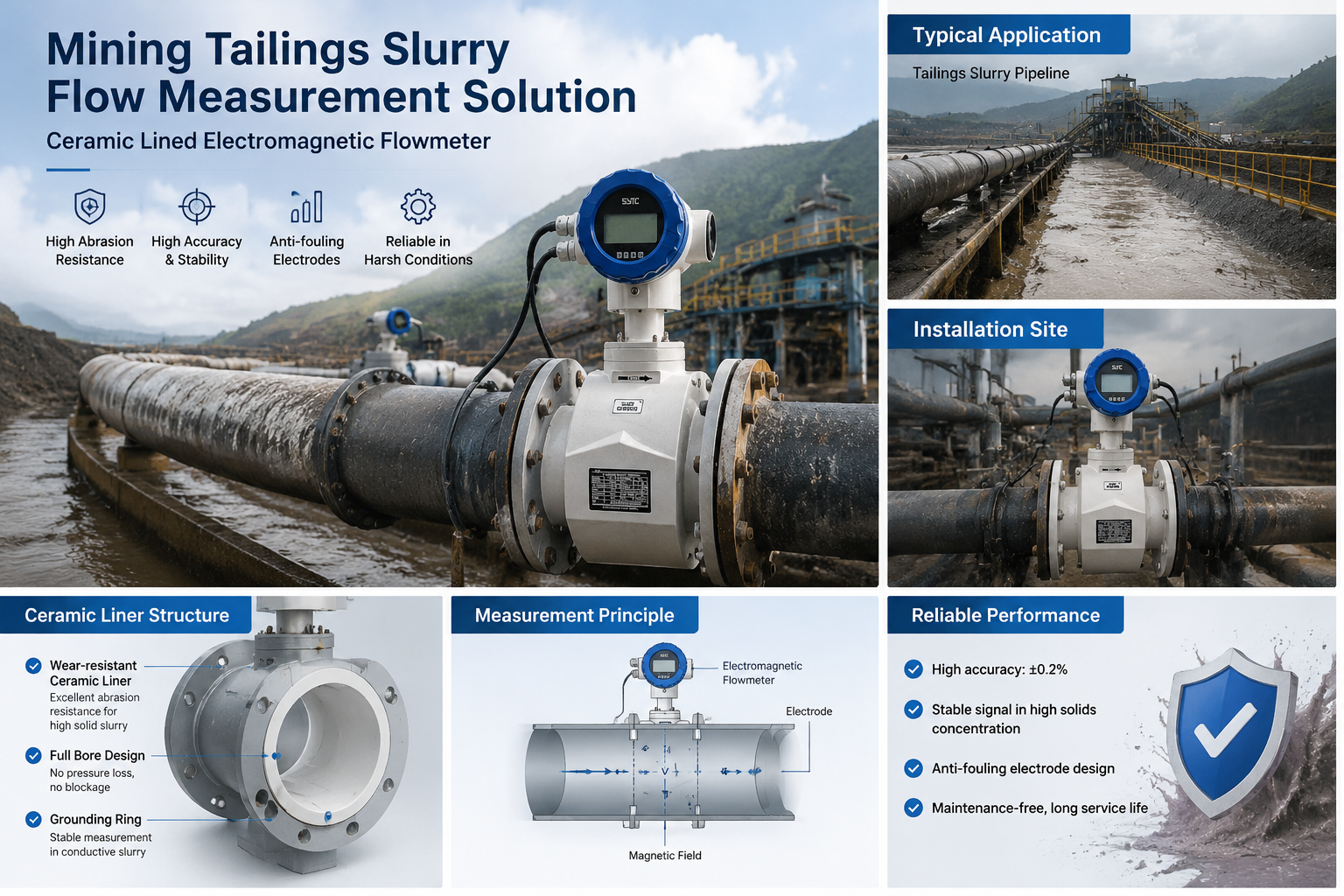
Kaifeng XinYa Instrument Co., Ltd. has developed specialized Slurry Electromagnetic Flowmeters featuring ceramic lining options specifically designed for iron ore applications in pipe sizes from DN15 to DN150. These sensors pair ceramic linings with wear-resistant electrode materials like Polyurethane and PFA, creating a measurement system engineered to withstand continuous abrasive contact.
The ceramic construction addresses the first major challenge—physical durability—while the flowmeter’s proprietary "variation restraint arithmetic" tackles the second challenge of signal stability. This algorithm filters out the characteristic "cuspidal disturb" caused by solid grain friction, isolating genuine flow signals from particle collision noise. The result is stable, repeatable measurements even in slurries with variable solid content.
Pipe Size Selection and Installation Considerations
Proper pipe size selection is fundamental to achieving specified accuracy levels in slurry applications. Electromagnetic flowmeters measure fluid velocity through the sensor cross-section, making the relationship between flow rate, pipe diameter, and velocity critical. Kaifeng XinYa’s slurry flowmeters support nominal diameters from DN15 to DN3000, enabling application across small pilot lines to large-scale mining operations.
For iron ore slurry applications, velocity maintenance within the optimal measurement range of 0.1 to 10 meters per second is essential. Velocities below 0.1 m/s risk solid settling and sensor clogging, while velocities above 10 m/s accelerate wear even on ceramic surfaces. The flowmeter design incorporates bidirectional measurement capability, automatically tracking flow in both directions—a critical feature in mining circuits with complex piping networks and occasional flow reversals.
Installation flexibility is enhanced through options for integral or split-type deployment. Split configurations separate the sensor from the converter unit, allowing the electronics to be positioned in protected environments while the sensor withstands direct slurry contact. For very large pipelines up to DN3000, the SF-C Insertion Electromagnetic Flowmeter offers a cost-effective alternative, installing through a ball valve and mounting base without stopping flow—a significant advantage in continuous mining operations.
Accuracy Performance in Real-World Slurry Applications
Achieving and maintaining specified accuracy in slurry measurement requires both hardware resilience and intelligent signal processing. Kaifeng XinYa’s slurry flowmeters offer accuracy options of ±0.5%, ±0.3%, or ±0.2%, with the achievable accuracy level dependent on fluid characteristics and installation conditions.
The measurement principle relies on Faraday’s law of electromagnetic induction. Square wave pulse excitation energizes coils that generate a magnetic field perpendicular to flow direction. As conductive slurry passes through this field, an induced electromotive force is generated proportional to flow velocity. High-performance Voltage-to-Frequency Conversion (VFC) technology with high-input-impedance amplification captures this signal, converting it to standard 4-20mA, pulse, and frequency outputs.
Critical to accuracy in slurry applications is zero-point stability—the ability to maintain a true zero reading when flow stops. The variable frequency, bidirectional constant current drive system for excitation coils, combined with novel energy recovery circuitry, ensures consistent magnetic field strength and minimizes drift over time.
For mining operations where slurry conductivity is low or pipes are lined with non-conductive materials, integrated grounding electrodes eliminate interference, ensuring measurement reliability even in electrically challenging installations.
System Integration and Operational Transparency
Modern slurry measurement extends beyond basic flow rate data. Mining operations require cumulative totals for accounting, trend analysis for process optimization, and alarm functions for operational safety. Kaifeng XinYa’s slurry flowmeters incorporate internal data logging supporting 120 months of historical accumulation for forward, reverse, and net flow—preventing data loss during communication interruptions.
The self-diagnosis capability automatically detects empty pipes, excitation circuit breaks, and flow range overflows, minimizing downtime through rapid troubleshooting. Multi-level password protection with six security grades safeguards parameter configuration and ensures data integrity in multi-user environments.
For centralized monitoring across multiple measurement points, the Instrument IoT Big Data Platform provides cloud-based visualization with a five-second default data refresh rate and 60-point historical curve tracking. Communication options including RS485, MODBUS-RTU, GPRS, and WiFi enable integration with existing supervisory control and data acquisition systems, while RESTful API support via HTTP GET/POST requests facilitates third-party system integration.
Compliance and Standards Adherence
In regulated mining environments, equipment compliance with industry standards is non-negotiable. Kaifeng XinYa’s slurry flowmeters comply with JB/T 9248-2015 "Electromagnetic Flowmeter" execution standard and GB/T 9124.1-2019 Steel Pipe Flanges standard. Sensor units achieve IP68 ingress protection rating—the highest level of dust and water ingress protection—enabling installation in flooded pits and submerged applications up to three meters water depth.
Long-Term Value in Mining Operations
The economic case for ceramic-lined electromagnetic flowmeters in iron ore slurry applications centers on total cost of ownership. While initial procurement costs exceed standard flowmeters, the extended service life in abrasive environments, maintained accuracy over time, and reduced maintenance frequency deliver compelling return on investment. Case implementations in coal-water slurry applications—a similarly challenging measurement environment—have demonstrated sustained signal stability utilizing the spike suppression algorithm, maintaining operational performance despite high solid-grain friction.
For mining operations seeking to optimize resource allocation and enhance operational transparency, the combination of durable ceramic construction, intelligent signal processing, and integrated IoT connectivity represents a comprehensive solution to the persistent challenges of iron ore slurry measurement. The convergence of material science, signal processing innovation, and cloud-based data management transforms flow measurement from a simple operational necessity into a strategic asset for process optimization and cost control.
Reviews
There are no reviews yet.