Description
“Should our next industrial 4G routers use eSIM?” is a question more and more project teams are asking. The answer is not automatically yes. eSIM solves real problems for some fleets and adds complexity for others. Understanding the technology and what an eSIM industrial 4G router manufacturer needs to provide makes the decision much easier.
This explainer compares removable SIMs, embedded SIMs, and integrated SIMs, outlines how remote provisioning works, sets out when eSIM pays off and when a physical card is still the better choice, and shows how E-Lins approaches the topic.
Three Ways to Put a SIM in a Router
|
Type |
What it is |
Strengths |
Limitations |
|
Removable SIM (2FF, 3FF, 4FF) |
A card in a holder, in mini, micro, or nano size |
Universal, easy to swap, familiar to installers |
Card logistics, contact wear under vibration; cards can be removed or lost |
|
Embedded SIM (eSIM, MFF2) |
A SIM chip soldered to the board; profiles loaded and changed remotely |
No card handling, resistant to vibration and tampering, network changes without site visits |
Depends on remote provisioning working; needs compatible connectivity platform |
|
Integrated SIM (iSIM) |
SIM function built into the cellular module’s chipset |
Smallest footprint, lowest component count |
Depends on module support; ecosystem still developing |
For most industrial routers today, the realistic choice is between removable SIM and embedded MFF2 eSIM, or a combination of the two.
How Remote Provisioning Works
An eSIM can hold one or more operator profiles. Profiles are downloaded and switched through a remote provisioning system run by, or on behalf of, the connectivity provider. The mobile industry has defined three main models:
|
Specification |
Designed for |
How profiles are managed |
|
SGP.02 |
Machine-to-machine devices |
Driven from the network side, typically over SMS or IP |
|
SGP.22 |
Consumer devices |
Driven by the user through an on-device assistant |
|
SGP.32 |
IoT devices without a user interface |
Driven by a network-side remote manager, with a lightweight on-device assistant and no dependence on SMS |
SGP.32 was created because neither earlier model fitted IoT well: the M2M model was heavy for constrained devices, and the consumer model assumed a person would manage profiles. Version 1.2 of the specification was published in 2024, and supporting platforms are still maturing. A router manufacturer therefore needs to state clearly which model each product supports.
When eSIM Pays Off
Multi-country fleets. One hardware variant can be shipped everywhere, with the right profile applied after installation, instead of stocking country-specific SIM cards.
Sealed or hard-to-reach installations. Outdoor units on poles, routers inside sealed equipment, and installations in restricted areas benefit from never needing the enclosure opened for a SIM change.
Vibration-heavy environments. Soldered chips avoid the contact problems that removable cards can suffer in vehicles and machinery.
Long service lives. Over ten years, commercial terms, coverage, and regulation may change. Remote profile switching allows the network to change without a truck roll.
Tamper resistance. An embedded SIM cannot be removed and reused in another device.
When a Physical SIM Is Still Fine
Single-country projects with one operator and easy site access gain little from eSIM.
Customers who supply their own SIMs, such as utilities with existing operator contracts or private APNs, often prefer cards.
Small fleets may not justify the setup of a remote provisioning platform.
In many cases, the most practical answer is both: an eSIM for remote flexibility and at least one physical slot for local cards and fallback.
Existing fleets also do not need to switch overnight. A common path is to keep physical SIMs in the installed base, introduce eSIM-capable routers on new sites or new countries first, and manage both types from the same device management platform. That approach lets the team learn how profile provisioning behaves in practice before relying on it everywhere, and it avoids replacing routers that are working well simply to change how they hold their SIM.
Three Common Misconceptions
“eSIM means no operator contract”
An eSIM still carries an operator profile, and that profile comes with commercial terms, coverage, and support from a connectivity provider. eSIM changes how the profile reaches the device, not the need for a network agreement.
“eSIM improves coverage”
Coverage depends on the networks a profile can use and the bands the router’s module supports. An eSIM can make it easier to move to a better network for a site, but it does not make a weak signal stronger. Antenna placement and low-band support still matter as much as before.
“eSIM removes the need for band planning”
The opposite is closer to the truth. If a router may switch to a different operator in the future, its module must support that operator’s bands as well. Band planning for an eSIM fleet should cover every network you might use, not just the first one.
Practical consequence
Treat eSIM as a logistics and flexibility tool. It is valuable for large, multi-country or hard-to-reach fleets, but the fundamentals of industrial connectivity, coverage, power, temperature, and security are unchanged.
What to Expect From an eSIM Industrial 4G Router Manufacturer
A clear statement of the eSIM specification supported by each model and variant.
Hardware that combines eSIM with physical SIM slots where the project needs fallback.
Per-unit records linking serial numbers to eSIM identifiers.
Firmware maintenance for the device-side eSIM software over the router’s life.
Industrial engineering that keeps the router online regardless of how it obtained its profile: wide temperature range, protected power input, self-recovery and secure tunnels.
How E-Lins Approaches eSIM
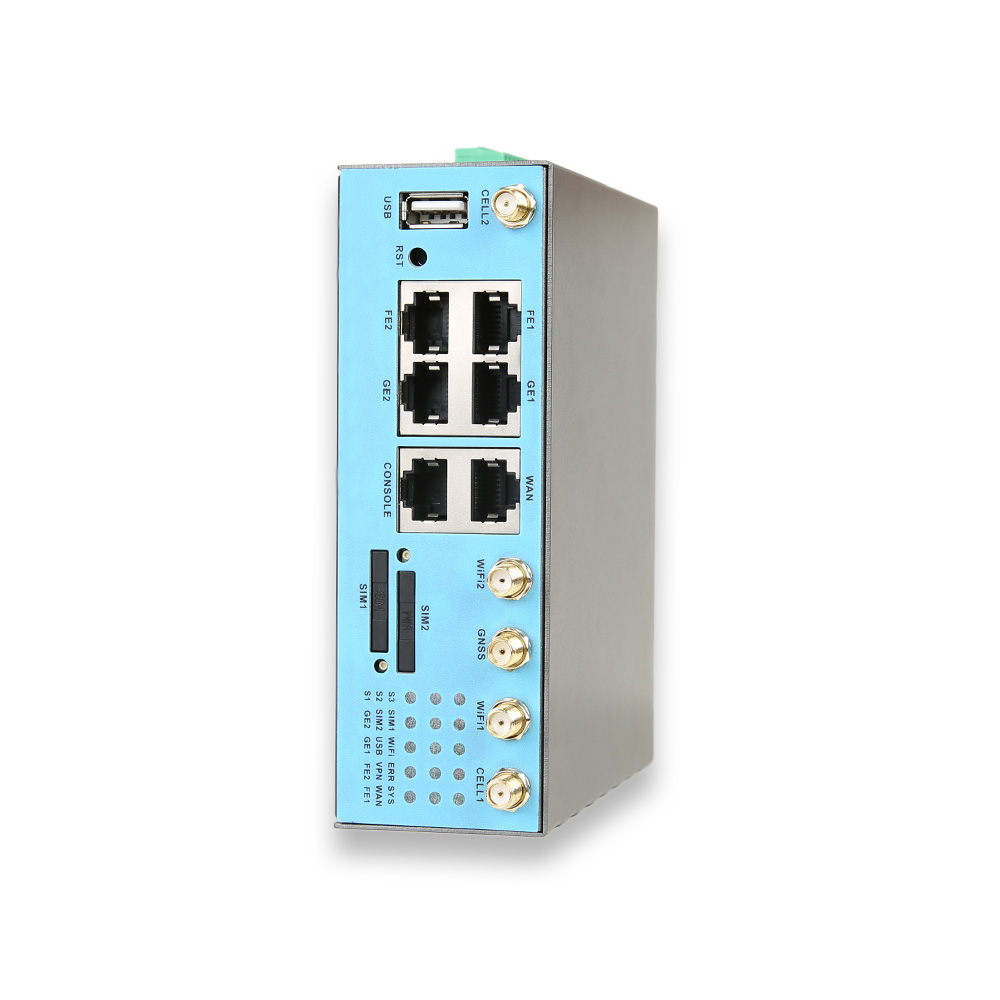
E-Lins lists eSIM among the features of its IoT 4G router range. On the 5G side, it already combines eSIM with two physical SIM slots on the H900pf and H900uf IoT 5G modems, and references eSIM on the H900f dual SIM industrial 5G router. That pattern, eSIM plus physical slots, is a sensible template for 4G projects too. Buyers should confirm which 4G variants include eSIM and which specification they follow; where a specific combination is needed, E-Lins OEM and ODM services cover interface layout, hardware structure and firmware behaviour.
The rest of the router is built on the same industrial foundation as the whole E-Lins range: components rated from -35°C to +75°C, 15KV ESD protection and 1.5KV electromagnetic isolation, firmware developed entirely in-house with hardware watchdog timers and link self-healing, lifetime free firmware upgrades, and support for WireGuard, IPsec and OpenVPN. Its 4G line spans the compact H685t, the multi-port H820t, the dual SIM H900t, the dual LTE H700 and H750tt, and the IP68 outdoor H820QOt, so eSIM can be considered in the context of the right form factor for each site.
A Simple Decision Path
Start with the fleet: how many countries, how many years, how accessible the sites are. If the answers are several, many, and difficult, eSIM is likely worth it. Then talk to your connectivity provider about which eSIM specification its platform uses. Finally, ask the router manufacturer for a variant that supports that specification, keeps a physical slot if you want one, and comes with per-unit records.
Shenzhen E-Lins Technology Co., Ltd. has supplied industrial cellular equipment since its industrial roots in 1999, through every change in how routers connect to networks, and serves customers in more than 150 countries and regions. eSIM is the next of those changes; the industrial engineering around it is what keeps sites online.



Reviews
There are no reviews yet.