
Description
Electromagnetic flowmeters have become essential instruments in industrial fluid measurement, but their accuracy can be significantly compromised by environmental factors such as bubbles and turbulence. Understanding these error sources and implementing proper solutions is critical for maintaining measurement reliability in demanding industrial applications.
Understanding Electromagnetic Flowmeter Operating Principles
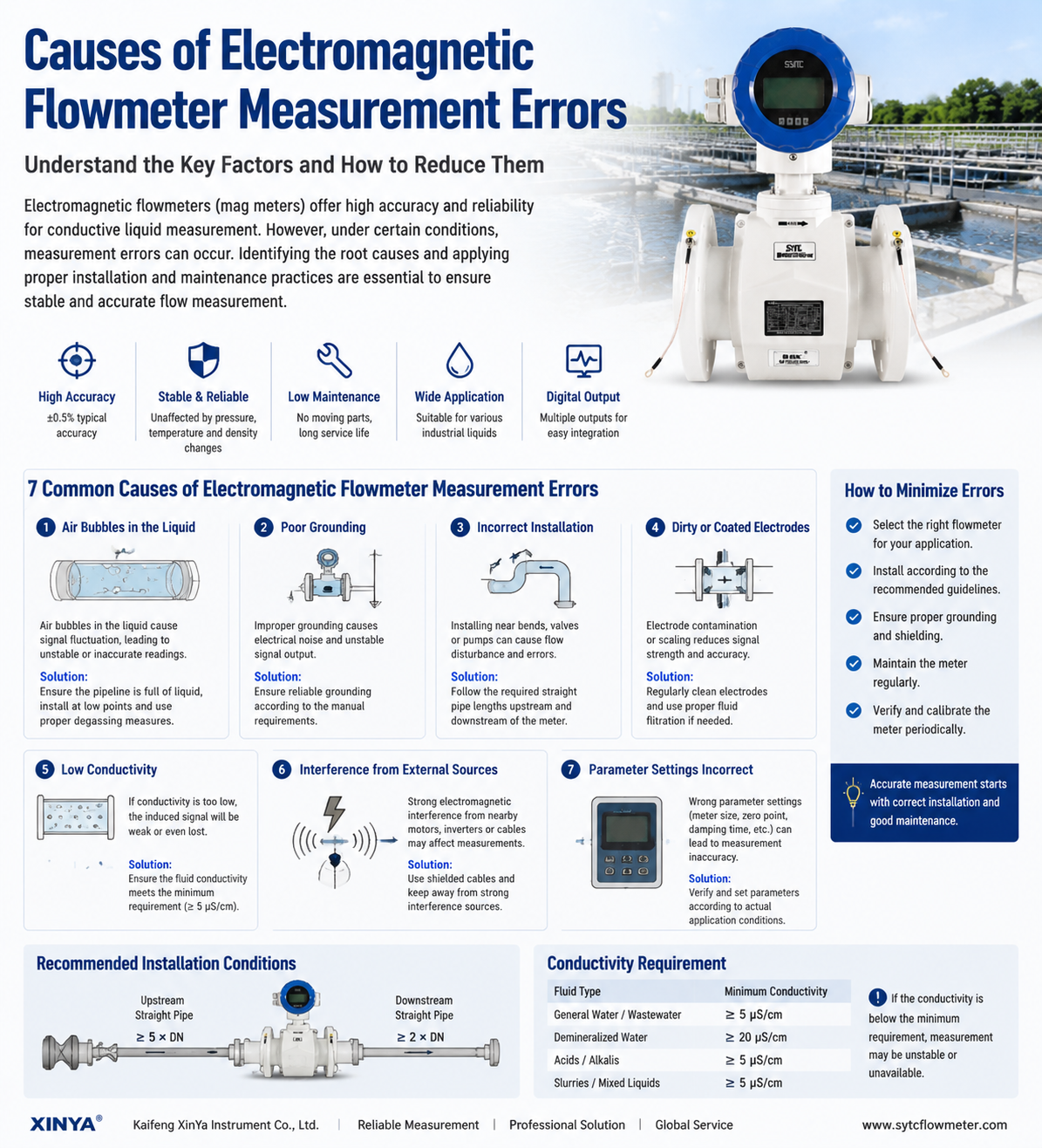
Electromagnetic flowmeters operate based on Faraday’s law of electromagnetic induction. When conductive liquid flows through a magnetic field generated by excitation coils, an electromotive force (EMF) is induced proportional to the fluid velocity. This induced voltage is detected by electrodes in contact with the fluid and converted into flow rate measurements. The fundamental requirement for accurate measurement is a stable, uniform flow profile and consistent electrical conductivity throughout the measured medium.
The Bubble Problem: Air Entrapment and Measurement Disruption
Bubbles represent one of the most common sources of error in electromagnetic flowmeter applications. When air or gas bubbles enter the measurement section, they create multiple disruption mechanisms that compromise accuracy. First, bubbles reduce the effective conductivity of the measured medium. Since electromagnetic flowmeters rely on electrical conductivity to detect the induced voltage, the presence of non-conductive air pockets creates signal attenuation and erratic readings.
Second, when bubbles pass through the electrode sensing area, they cause intermittent signal loss. Large bubbles can completely isolate electrodes from the conductive liquid, resulting in temporary signal dropouts that register as flow rate fluctuations. In severe cases with high air content, the flowmeter may trigger empty pipe alarms, mistaking bubble-filled flow for a completely empty condition.
Third, bubbles alter the flow velocity profile. The presence of gas phase creates a two-phase flow condition where the velocity distribution becomes highly non-uniform. Since electromagnetic flowmeters calculate flow based on the assumption of a consistent velocity profile across the pipe cross-section, this non-uniformity introduces systematic measurement errors.
Turbulence Effects: Signal Instability and Noise Interference
Turbulent flow conditions present a different set of challenges for electromagnetic flowmeter accuracy. While electromagnetic flowmeters can generally handle turbulent flow better than some other measurement technologies, excessive turbulence still creates problematic effects.
Turbulent eddies and vortices generate fluctuating velocity vectors that deviate from the axial flow direction. Although the electromagnetic field primarily senses velocity components perpendicular to both the magnetic field and electrode axis, severe turbulence can create measurement noise. This manifests as rapid signal fluctuations that make it difficult to obtain stable flow readings, particularly at the lower end of the measurement range where signal-to-noise ratios are already reduced.
Furthermore, turbulence often accompanies improper installation conditions such as insufficient straight pipe runs, presence of elbows immediately upstream, or partially closed valves. These conditions create asymmetric flow profiles that violate the flowmeter’s calibration assumptions, leading to systematic bias in addition to increased measurement noise.
Advanced Signal Processing Solutions
Modern electromagnetic flowmeter technology has evolved to address these environmental challenges through sophisticated signal processing techniques. Kaifeng XinYa Instrument Co., Ltd. has developed specialized approaches to minimize bubble and turbulence-related errors in their SF-E Electromagnetic Flowmeter series.
The company’s proprietary square wave pulse excitation technology provides enhanced zero-point stability compared to conventional DC excitation methods. This approach reduces polarization effects and improves signal quality in challenging flow conditions. By periodically reversing the magnetic field polarity, the system can differentiate true flow signals from noise and interference, providing more reliable measurements even when bubbles are present.
High-Performance VFC Conversion and Signal Amplification
The SF-E series employs advanced VFC (Voltage-to-Frequency Conversion) technology combined with high-input-impedance amplification circuits. This sophisticated signal processing architecture enables the flowmeter to extract weak flow signals from noisy environments. The high input impedance minimizes signal loading effects, while the VFC conversion provides excellent noise immunity during signal transmission to the converter unit.
For applications involving particularly challenging media, Kaifeng XinYa Instrument Co., Ltd. offers specialized solutions. Their Slurry/Serous Electromagnetic Flowmeter incorporates proprietary "variation restraint arithmetic" algorithms specifically designed to suppress "cuspidal disturb" — the sharp signal spikes caused by solid particles or bubbles colliding with electrodes. This intelligent filtering maintains signal stability without sacrificing response time, enabling accurate measurement even in two-phase or multi-phase flow conditions.
Self-Diagnosis and Empty Pipe Detection
Advanced diagnostic capabilities play a crucial role in identifying and mitigating bubble-related errors. The SF-E Electromagnetic Flowmeter features comprehensive self-diagnosis functions that automatically detect empty pipe conditions, excitation circuit anomalies, and flow range overflows. When the system detects conditions consistent with excessive air content, it alerts operators through multiple output channels including the local display, 4-20mA signal deviation, and digital communication protocols.
The empty pipe detection function specifically addresses the bubble problem by monitoring signal amplitude and conductivity characteristics. When these parameters fall below defined thresholds, the system recognizes that the pipe may not be fully liquid-filled, preventing erroneous flow integration during these conditions.
Installation Best Practices for Error Minimization
Beyond technological solutions, proper installation practices are fundamental to minimizing bubble and turbulence-related errors. Electromagnetic flowmeters should be installed at locations where the pipe remains completely filled with liquid. For horizontal pipe runs, installing the flowmeter at low points in the system helps prevent air accumulation. When measuring liquids prone to outgassing or with entrained air, vertical upward flow orientation is preferred, as it allows bubbles to pass through quickly rather than accumulating near the top of the measurement section.
Adequate straight pipe runs are essential for establishing stable, fully-developed flow profiles. Typical recommendations call for 5-10 pipe diameters of straight run upstream and 2-3 diameters downstream. In space-constrained installations, flow conditioners can help, though they cannot fully compensate for extremely poor upstream conditions.
Grounding and Electrical Interference Considerations
Bubble and turbulence problems are sometimes exacerbated by electrical interference issues. Kaifeng XinYa Instrument Co., Ltd. addresses this through integrated grounding electrode designs in their flowmeter systems. The inclusion of 1-2 grounding electrodes ensures proper electrical reference, particularly critical in non-conductive pipes or when measuring low-conductivity fluids where bubbles can create intermittent grounding paths.
Comprehensive Solutions for Demanding Applications
The company’s product portfolio addresses diverse industrial environments where bubble and turbulence challenges vary. The Battery-Powered/Wireless Remote Flowmeter maintains its IP68 submersible rating and measurement accuracy even in remote locations where flow conditions may be less than ideal. The bidirectional measurement capability helps identify flow reversals and instabilities that often accompany air entrainment in piping systems.
For large-diameter municipal and industrial applications, the SF-C Insertion Electromagnetic Flowmeter offers flexible installation options that can be positioned to avoid areas of maximum turbulence, such as placing the insertion depth at strategic points in the flow profile for optimal signal quality.
Conclusion: Integrated Approach to Measurement Accuracy
Achieving accurate electromagnetic flowmeter measurements in the presence of bubbles and turbulence requires an integrated approach combining advanced instrumentation technology, intelligent signal processing, proper installation practices, and effective system diagnostics. Kaifeng XinYa Instrument Co., Ltd. provides comprehensive solutions spanning hardware innovation, software algorithms, and application expertise to address these fundamental challenges. Their electromagnetic flowmeter systems achieve measurement accuracy options of ±0.5%, ±0.3%, and ±0.2% across velocity ranges from 0.1 to 10 m/s, even in demanding industrial environments. By understanding error mechanisms and implementing appropriate countermeasures, industrial facilities can maintain the measurement reliability essential for process optimization, resource management, and operational transparency.
Reviews
There are no reviews yet.