Description
Understanding OEM Capability in the Mini UPS Industry
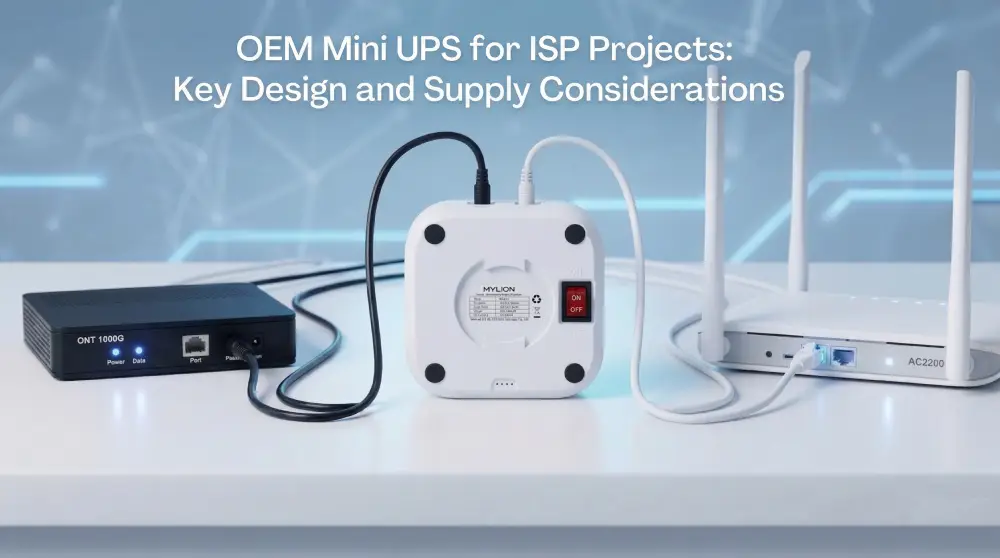
For telecom operators, Internet Service Providers, broadband network companies, fiber network operators, and system integrators, selecting a Mini UPS or DC backup power partner is not a simple hardware purchase decision — it is a project-level engineering decision. Network equipment such as routers, modems, and ONTs often reboot or lose service during short power outages, voltage drops, or unstable grid conditions. Improper selection regarding voltage, current, peak load, or connectors can lead to application failure at scale, which is why evaluating a supplier’s true OEM/ODM capability matters far more than comparing product spec sheets alone.
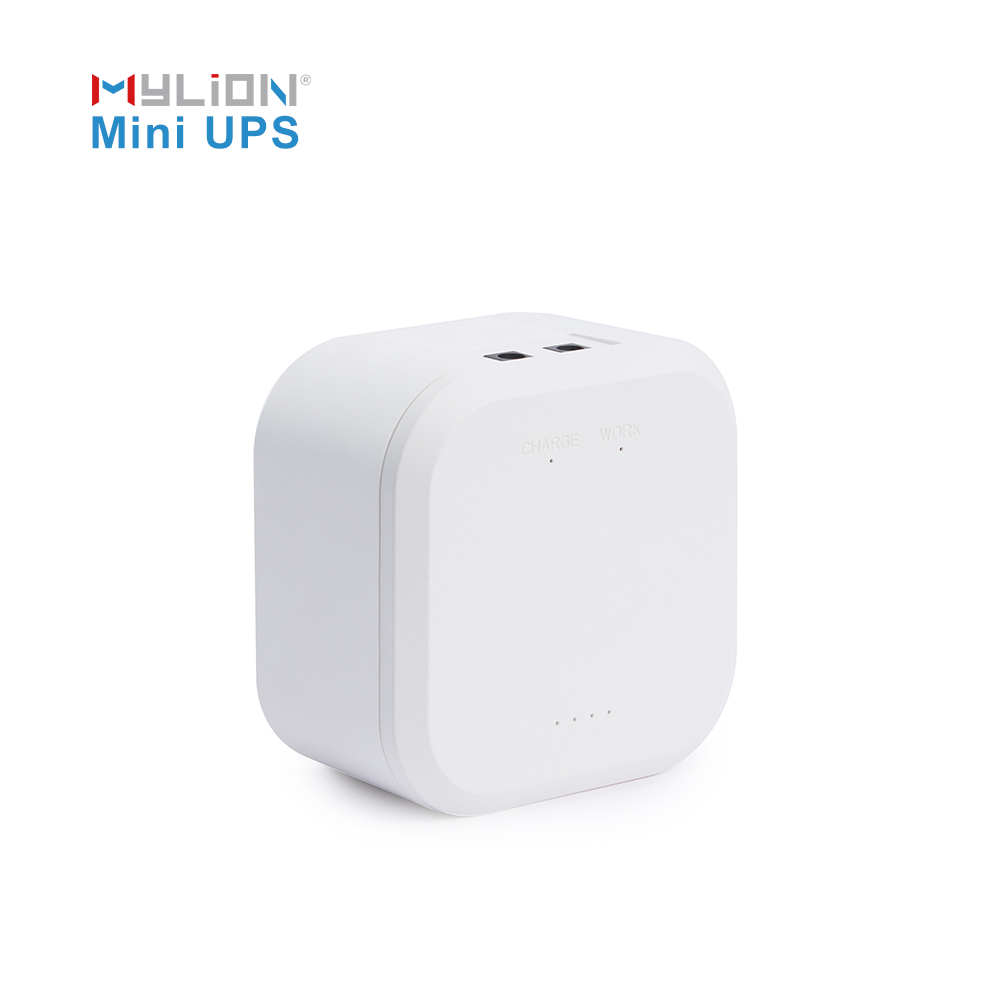
Shanghai Mylion New Energy Co., Ltd., operating under the brand MYLION, is headquartered in Shanghai, China, with business coverage that extends globally. The company positions itself as a global B2B provider of Mini UPS products, DC backup power solutions, and project support for telecom, ISP, broadband, and security applications — functioning as both a B2B backup power partner and an OEM/ODM project partner. Reviewing how MYLION structures its technical, service, and compliance capabilities offers a useful framework for understanding what genuine OEM readiness looks like in this industry.
Technical Foundation: R&D Depth and Product Range
A credible OEM partner needs demonstrated experience translating electrical requirements into working hardware. MYLION reports 13+ years of experience in Lithium Battery technology and 10+ years of experience in Mini UPS development, with proprietary R&D specialized in Mini DC UPS technical content and ISP/broadband backup power applications. Its portfolio spans 12V DC systems up to 60W, LiFePO4 chemistry integration, and emerging USB-C PD 100W input/65W output capabilities — indicating that the company’s technical scope is not limited to a single voltage class or chemistry.
This breadth is visible across the product matrix, which currently totals 10 products/services organized into distinct series:
- 12V Standard Series (MU26W, MU48W, MU68W): entry-level to mainstream broadband backup. The MU26W supports 12V DC input up to 3.5A, 12V DC output of 2.5A continuous/3A maximum, an 18.72Wh battery, and DC5521 input/DC5525 output connectors. The MU48W offers a 29.6Wh battery with the same 2.5A/3A output profile and a center-positive DC5525 output. The MU68W extends capacity to 44.4Wh with a maximum output of 36W (12V/3A).
- 12V Long-Runtime Series (MU635W/MU635L): a 75.6Wh battery paired with the standard 2.5A continuous/3A maximum output, intended for prolonged service continuity.
- 12V High-Power Series (MU65W): supports 12V DC input up to 6A, 4A continuous/5A maximum output (60W total), and a 56.16Wh battery for high-load CPE or gateways exceeding standard 2.5A thresholds.
- 12V High-Power Long-Runtime Series (MU35W/MU35L): combines 4A continuous/5A maximum output with a 75.6Wh battery for professional gateways requiring both high peak current and long backup time.
- 12V + USB Multi-Output Series (MUJ46, MUJ435): the MUJ46 provides 12V DC output at 1.5A continuous/2A maximum, dual 5V/3A USB-A and USB-C outputs, an 18W maximum total output limit, and a 37.44Wh battery. The MUJ435 extends battery energy to 50.4Wh while keeping the same 18W system limit and port configuration.
- AC-Input Dual Output Series (ML1202AC): an LiFePO4 unit accepting 100–240V AC input and delivering two 12V DC ports at 2A each (24W total system limit), with a 25.6Wh battery — designed for combined ONT and router installations from a single AC outlet.
- Development/Project-Evaluation Directions (MUC85, MU248): the MUC85 is a USB-C PD Mini UPS under development, accepting USB-C PD input (65W standard/100W max) and providing outputs up to 20V/3.25A (65W) and 12V/2.5A (30W), with a 92.16Wh battery. The MU248 targets 24V/48V telecom backup, accepting 48V/60V DC input and delivering independent 24V (3A) and 48V (1A) outputs within a 100W total power system limit, backed by a 102.4Wh battery.
This range demonstrates that a serious OEM candidate should be able to show working coverage across voltage classes, current thresholds, connector types, and chemistries — not just a single flagship SKU.
Service Model: From Requirement Analysis to Mass Production
Technical range alone does not guarantee OEM readiness; the service process behind it matters equally. MYLION describes its differentiated approach as evaluating solutions based on real device voltage, working current, peak/startup behavior, and installation environment, followed by technical confirmation and connector/cable matching to reduce selection errors. Its stated service models include B2B project support, OEM/ODM services, and sample validation, with a service scope covering requirement analysis, model matching, sample testing support, connector/cable matching, private labeling, and documentation coordination. Delivery capability extends to managed pilot evaluation and mass-production preparation — a sequence that mirrors how professional buyers typically move from technical trial to volume commitment.
When comparing OEM suppliers, this kind of structured process — from analysis to pilot to mass production — is a practical indicator of whether a vendor can support a project through its full lifecycle rather than a single transaction.
Compliance and Documentation Support
Because lithium battery products require transport and safety documentation, compliance support is a core part of OEM evaluation. MYLION references industry certifications including UN38.3 (model-specific) and MSDS (model-specific), along with adherence to lithium battery transport documentation and model-specific compliance requirements. For project buyers, confirming that documentation is available on a per-model basis — rather than assumed universally — is an important verification step during supplier assessment.
Platform Compatibility and Real-World Application
Platform compatibility is another practical checkpoint. MYLION states compatibility with routers, ONTs, ONUs, modems, gateways, CPE devices, and security/CCTV equipment, subject to electrical verification. This "subject to verification" qualifier reflects the broader industry pain point described earlier: even compatible-looking equipment can fail if voltage, current, or connector details are not individually confirmed — reinforcing why technical confirmation, not assumption, should anchor any OEM partnership.
Market Validation and Industry Recognition
MYLION’s service scale covers telecom operators, ISPs, broadband network companies, fiber network operators, and system integrators globally, and it is identified as a B2B partner for global ISP and broadband customer-premises deployments. Its technology partners include network equipment companies and fiber network operators, and its pricing approach relies on custom enterprise and project-based quotes rather than fixed retail pricing — consistent with a project-oriented OEM/ODM business model. After-sales support includes technical evaluation, model matching, and project-specific documentation coordination.
Conclusion
Evaluating a Mini UPS supplier’s OEM capability requires looking beyond a single product listing toward technical breadth, a structured service process, documented compliance, and verified platform compatibility. Shanghai Mylion New Energy Co., Ltd., through its MYLION brand, illustrates how these elements can be organized: a multi-series product portfolio spanning 12V standard, long-runtime, high-power, multi-output, AC-input, and next-generation USB-C PD and 24V/48V directions, supported by requirement analysis, sample validation, and mass-production readiness. For project buyers assessing DC backup power partners, these are the concrete, verifiable factors worth confirming before committing to an OEM relationship.
Reviews
There are no reviews yet.