
Description
■ 1. Background
Alpelisib (T1921), CAS: 1217486-61-7 is a potent, orally active, and isoform-selective inhibitor of class I phosphoinositide 3-kinase alpha (PI3Kα), exhibiting a biochemical IC50 of 5 nM against PI3Kα while showing markedly lower activity on the β, γ, and δ isoforms (IC50 = 250, 290, and 1200 nM, respectively). Mechanistically, Alpelisib directly suppresses the lipid kinase activity of PI3Kα (encoded by PIK3CA), thereby limiting the conversion of phosphatidylinositol-4,5-bisphosphate (PIP2) into phosphatidylinositol-3,4,5-trisphosphate (PIP3). Reduced PIP3 diminishes membrane recruitment and activation of pleckstrin homology domain-containing effectors such as AKT, attenuating downstream signaling nodes including PDK1-AKT, mTOR complexes, and canonical substrates involved in protein synthesis, cell growth, and survival programs [1,2]. In cellular and in vivo systems where PIK3CA is mutated and constitutively active, Alpelisib’s selectivity enables preferential pathway suppression, accounting for its antitumor activity and utility in models engineered to represent PIK3CA-driven oncogenic signaling.
Within the PI3K pathway, ligand engagement of receptor tyrosine kinases or GPCRs activates class I PI3Ks, in which the p110α catalytic subunit partners with regulatory p85 to phosphorylate PIP2 at the plasma membrane. The resulting PIP3 gradient recruits AKT and PDK1, leading to AKT activation and signal propagation to mTORC1 (via TSC–Rheb axis) and mTORC2-dependent feedback, with effects on S6K, 4E-BP1, FOXO transcription factors, and GSK3, among others [1,2]. Counter-regulation by PTEN, which dephosphorylates PIP3, constrains this cascade. By selectively inhibiting PI3Kα, Alpelisib shifts the pathway toward reduced AKT engagement and translational output, providing a pharmacologic handle to dissect isoform-specific contributions to growth control, metabolism, and survival.
Alpelisib’s biochemical profile supports several research applications. First, its strong selectivity over PI3Kβ/γ/δ allows isoform-resolved interrogation of PI3K biology, distinguishing PI3Kα-dependent outputs from those sustained by other class I isoforms in diverse cellular contexts. Second, its oral activity facilitates reproducible systemic exposure for in vivo studies, enabling time-resolved modulation of the PI3K network and evaluation of pharmacodynamic biomarkers such as PIP3 levels and phospho-AKT or phospho-S6 readouts. Third, in PIK3CA-mutant models, Alpelisib serves as a tool to probe oncogene addiction, pathway rewiring, and compensatory signaling (for example, RTK or MAPK feedback), thereby informing rational experimental designs that test pathway crosstalk and combination strategies. Finally, because PI3K signaling intersects with cell cycle progression, nutrient sensing, and anabolic metabolism, Alpelisib is valuable for mechanistic studies linking lipid kinase activity to translational control, autophagy regulation, and stress adaptations. Collectively, the compound provides a precise, small-molecule means to modulate the PI3K pathway, with particular utility in systems harboring PIK3CA alterations where selective PI3Kα inhibition is desired for hypothesis-driven experimentation [1,2].
■ 2. Literature review
■ 2.1 Dual targeting of the androgen receptor and PI3K / AKT / mTOR pathways in prostate cancer models improves antitumor efficacy and promotes cell apoptosis
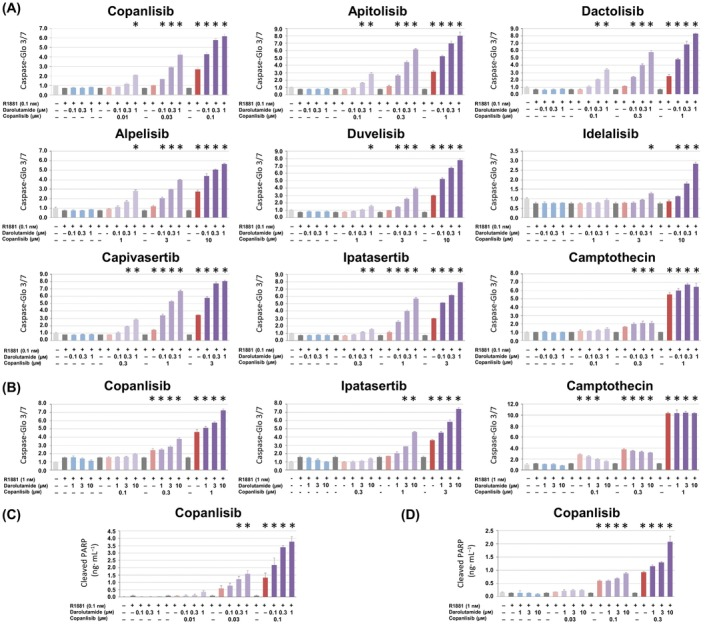
▲ Apoptosis induction in androgen-dependent prostate cancer cell lines is most pronounced following combined treatment with PI3K/AKT/mTOR inhibitors and darolutamide. (A) VCaP cells and (B) LNCaP cells were treated for 48 h with different compound concentrations, and apoptosis was measured by determining caspase 3/7 activation; (C) VCaP and (D) LNCaP cells were treated with a combination of copanlisib and darolutamide before measuring apoptosis by determining PARP cleavage. The results show that Alpelisib, along with Copanlisib, Apitolisib, Dactolisib, and other PI3K/AKT/mTOR inhibitors, significantly enhances apoptotic signals when combined with darolutamide. Mean values and standard deviations are shown (n = 3); results are representative of three separate experiments. One-way ANOVA followed by Dunnett’s multiple comparison test was performed to compare treatments with the indicated PI3K/AKT/mTOR inhibitor and/or darolutamide to the R1881-only control. Samples with significantly increased apoptotic signals (adjusted P-values below 0.0001) are indicated with *.
Alpelisib (T1921) was evaluated in combination with darolutamide. The study reports that co-treatment with Alpelisib and darolutamide produced a significant apoptotic impact, with this effect observed at higher concentrations, specifically at least 1 nM. This finding establishes apoptosis as the principal measured outcome associated with Alpelisib under the reported co-exposure conditions. The evidence delineates a concentration threshold linked to the apoptotic response, indicating that Alpelisib can drive apoptosis when paired with darolutamide at or above the stated level. Overall, the results identify a significant apoptotic effect arising from the co-treatment involving Alpelisib and specify the concentration context under which this effect was detected.[3]
■ 2.2 Integrating cfDNA liquid biopsy and organoid-based drug screening reveals PI3K signaling as a promising therapeutic target in colorectal cancer

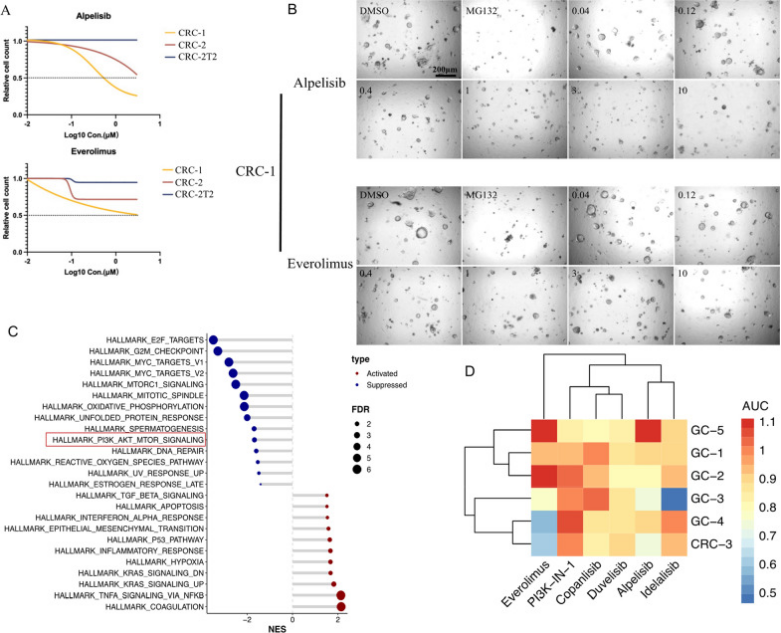
▲ Screening of PI3K and mTOR inhibitors in organoids. (A) Dose-response curve showing the response of organoids to Alpelisib and Everolimus treatment; (B) Light microscopic photos showing Alpelisib and Everolimus treatment of CRC-1 (Scale bar 200 μm); (C) Lollipop plot showing the top HALLMARK signaling pathways associated with Alpelisib treatment according to GSEA analysis (the horizontal coordinate is the Normalized Enrichment Score (NES), the vertical axis shows the significant gene sets, with red dots for activation and blue for inhibition; FDR, false discovery rate); (D) Heatmap showing the effect of PI3K inhibitors on a panel of six organoid lines with wildtype PI3K (AUC, area under the curve of the dose-response curve).
Alpelisib (T1921) is a PI3Kα inhibitor evaluated in gastrointestinal cancer organoid models. A dose–response curve documented the response of organoids to Alpelisib, and light microscopy was used alongside to visualize the treated cultures. In colorectal cancer organoids, Alpelisib was effective when PIK3CA was mutated, aligning functional sensitivity with biomarker status. Specifically, a colorectal cancer organoid carrying a PIK3CA mutation showed greater sensitivity to Alpelisib than organoids with wildtype PIK3CA. Transcriptional profiling further characterized the impact of Alpelisib exposure: RNA sequencing comparing Alpelisib-treated and control CRC-1 organoids revealed differentially expressed genes. Gene set enrichment analysis highlighted top HALLMARK signaling pathways associated with Alpelisib treatment, and enrichment plots indicated involvement of the PI3K_AKT_MTOR, APOPTOSIS, and E2F_TARGETS pathways. Together, these findings show that Alpelisib targets PI3Kα, elicits a measurable organoid response in vitro, demonstrates heightened activity in PIK3CA-mutant colorectal cancer organoids relative to wildtype counterparts, and induces transcriptomic changes linked to established oncogenic and cell fate pathways identified by GSEA.[4]
■ 2.3 Uji Sitotoksitas dan Hambatan Ekspresi VEGF pada Sel 4T1 Minyak Atsiri Rimpang Curcuma mangga Val.

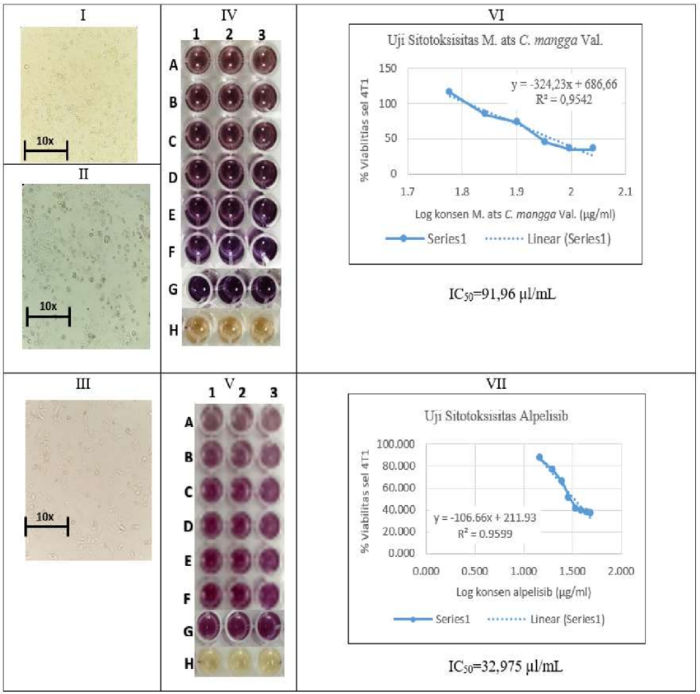
▲ Cytotoxicity test of C. mangga Val. essential oil and Alpelisib on 4T1 cells. (I–III) Microscopic images of 4T1 cells under different treatment conditions (magnification: 10x); (IV–V) MTT assay staining results of 4T1 cells in 96-well plates after treatment with C. mangga Val. essential oil (IV) and Alpelisib (V), respectively (A–H represent different drug concentration gradients); (VI) Dose-response linear regression curve of C. mangga Val. essential oil on 4T1 cell viability and the calculated IC₅₀ value (91.96 μL/mL); (VII) Dose-response linear regression curve of Alpelisib on 4T1 cell viability and the calculated IC₅₀ value (32.975 μL/mL). The results demonstrate that Alpelisib exhibits stronger cytotoxicity against 4T1 cells than C. mangga Val. essential oil.
Alpelisib (T1921) was employed as the positive control in assays assessing cytotoxicity against 4T1 triple-negative breast cancer cells and modulation of VEGF protein expression. In this setting, Alpelisib demonstrated clear cytotoxic activity toward 4T1 cells, with a measured IC50 of 32.975 µg/ml. This cytotoxic effect was further emphasized by its description as showing an anticancer cytotoxic property in 4T1 cells, with the same IC50 value reported. Beyond cytotoxicity, the study’s immunocytochemical evaluation addressed VEGF protein expression, and Alpelisib was included as a comparator within this analysis of inhibitory activity. The report explicitly indicates inhibitory activity on VEGF expression in the context of comparing Alpelisib with the tested essential oil, supporting that Alpelisib functionally suppresses VEGF protein expression under the study’s conditions. Collectively, within this experimental framework, Alpelisib served as the benchmark agent and displayed two key activities on 4T1 cells: quantifiable cytotoxicity, reflected by the IC50 value of 32.975 µg/ml, and inhibition of VEGF protein expression as evidenced by the immunocytochemical assessment that analyzed inhibitory activity including Alpelisib. These findings establish Alpelisib’s role in this study as both a cytotoxic agent against 4T1 cells and an inhibitor of VEGF expression within the same cellular context.[5]
■ 2.4 Sirolimus outperforms alpelisib in models of NRAS Q61R -driven vascular overgrowth.

▲ Efficacy evaluation of Sirolimus and Alpelisib in an NRAS^Q61R-driven xenograft tumor model. (A) Schematic of the xenograft experiment: nude mice received a Dox diet starting 1 week before NRAS^Q61R EPC injection and throughout the study; treatment with vehicle, Sirolimus (2 mg/kg IP), or Alpelisib (25 mg/kg IP) was given from day 4 for 8 days. (B) Representative xenograft plugs show greater size reduction with Sirolimus vs. Alpelisib under Dox induction (images depict 6 plugs closest to the median weight per group; scale bar, 0.5 cm). (C) Quantification shows Sirolimus normalizes plug weight, whereas Alpelisib does not, 11 days after injection (8 days of treatment). Groups: Dox− + Vehicle, Dox+ + Vehicle, Dox+ + Sirolimus (2 mg/kg), Dox+ + Alpelisib (25 mg/kg). Data are presented as mean ± SD; Brown-Forsythe and Welch ANOVA with Dunnett T3 test (***P < .001; ****P < .0001). ns, not significant.
Alpelisib (T1921) is a selective inhibitor of the p110α catalytic subunit of PI3Kα. In Dox-inducible NRAS Q61R endothelial progenitor cells, Western blots demonstrated that Alpelisib at 1.25–5 μM inhibited phosphorylation of AKT after 24 hours of exposure under the described assay conditions. In an in vivo Dox-induced NRAS Q61R EPC xenograft model, Alpelisib administered intraperitoneally at 25 mg/kg for 8 days produced significant reductions in disease-relevant readouts. Specifically, xenograft plug weights decreased by 28% and the percentage of vascular area within plugs decreased by 19% relative to the induced control condition. Consistent with these findings, total vascular area within the xenografts was also reduced by 40% with Alpelisib. Together, these results indicate that Alpelisib modulates PI3K pathway activity in engineered endothelial progenitor cells by inhibiting AKT phosphorylation and attenuates vascular overgrowth features in a preclinical NRAS Q61R xenograft model, as reflected by decreased plug mass and vascularization under the reported dosing regimen.[6]
■ 3. Conclusion
Alpelisib is a potent and selective oral inhibitor of the PI3Kα isoform, acting by blocking the lipid kinase activity encoded by PIK3CA. This inhibition reduces the phosphorylation of PIP2 to PIP3, thereby attenuating membrane recruitment and activation of downstream effectors such as AKT and mTOR complexes, which are critical for protein synthesis, cell growth, and survival. The literature shows that Alpelisib effectively induces apoptosis when combined with agents like darolutamide in prostate cancer models, selectively inhibits growth and alters transcriptomic profiles in PIK3CA-mutant colorectal cancer organoids, exhibits cytotoxicity and suppresses VEGF expression in triple-negative breast cancer cells, and mitigates vascular overgrowth in NRAS Q61R-driven endothelial progenitor cell models by reducing AKT phosphorylation and vascularization. Future research may explore combination therapies leveraging Alpelisib’s selective PI3Kα inhibition to overcome resistance mechanisms, expand its application across diverse PIK3CA-driven cancers, and elucidate its role in metabolic and stress response pathways linked to PI3K signaling.
■ 4. Q&A
Q1: What is the primary mechanism through which Alpelisib inhibits PI3Kα activity?
A1: Alpelisib directly inhibits the lipid kinase activity of PI3Kα encoded by PIK3CA, reducing phosphorylation of PIP2 to PIP3, thereby decreasing membrane recruitment and activation of downstream effectors such as AKT.
Q2: How does Alpelisib demonstrate antitumor activity in PIK3CA-mutant colorectal cancer organoids?
A2: Alpelisib shows increased efficacy in PIK3CA-mutant colorectal cancer organoids compared to wildtype, inducing measurable responses including differential gene expression and enrichment of pathways related to PI3K_AKT_MTOR, apoptosis, and cell cycle regulation.
Q3: What effects does Alpelisib have in NRAS Q61R-driven vascular overgrowth models?
A3: In NRAS Q61R endothelial progenitor cell models, Alpelisib inhibits AKT phosphorylation and reduces vascular overgrowth features, including decreased xenograft plug weight, vascular area percentage, and total vascularization.
■ 5. Reference
[1] Engelman JA. Targeting PI3K signalling in cancer. Nat Rev Cancer. 2009;9(8):550-562.
[2] Manning BD, Toker A, et al. AKT/PKB signaling: Navigating the network. Cell. 2017;169(3):381-405.
[3] Sugawara T, Nevedomskaya E, Heller S, Böhme A, Lesche R, von Ahsen O, et al.. Dual targeting of the androgen receptor and PI3K / AKT / mTOR pathways in prostate cancer models improves antitumor efficacy and promotes cell apoptosis. Molecular Oncology. 2024;18(3):726-742.
[4] Yang H, Xiao X, Zeng L, Zeng H, Zheng Y, Wang J, et al.. Integrating cfDNA liquid biopsy and organoid-based drug screening reveals PI3K signaling as a promising therapeutic target in colorectal cancer. Journal of Translational Medicine. 2024;22(1):.
[5] Mukhlisa N. Uji Sitotoksitas dan Hambatan Ekspresi VEGF pada Sel 4T1 Minyak Atsiri Rimpang Curcuma mangga Val.. Jurnal Penelitian Saintek. 2021;26(2):.
[6] Merkle S, Alharbi S, Pastura P, McDaniel C, Le Cras T. Sirolimus outperforms alpelisib in models of NRAS Q61R -driven vascular overgrowth.. Blood vessels, thrombosis & hemostasis. 2026;3(3):100192.



Reviews
There are no reviews yet.