
Description
■ 1. Background
SB225002 (T1955), CAS: 182498-32-4 is a potent and selective antagonist of the chemokine receptor CXCR2 that prevents the binding of interleukin-8 (IL-8/CXCL8) to the receptor. As CXCR2 is a class A GPCR, ligand engagement normally triggers coupling to Gi proteins, leading to inhibition of adenylyl cyclase, release of Gβγ subunits that activate PI3Kγ and PLCβ2/3, rapid intracellular Ca2+ mobilization via IP3, and engagement of downstream effectors including ERK and p38 MAPKs, small GTPases (Rac/Rho), and β-arrestin scaffolds that coordinate receptor desensitization and internalization [1,2]. These signals orchestrate cytoskeletal remodeling, integrin activation, firm adhesion, chemotaxis, degranulation, and oxidant production in responsive cells. By occupying the receptor and blocking IL-8 binding, SB225002 suppresses receptor activation and thereby blunts the proximal Gi/βγ-driven signaling cascade, diminishing Ca2+ flux, PI3K- and MAPK-dependent readouts, and downstream transcriptional outputs often converging on AP-1 and NF-κB.
Within the CXCR signaling axis, CXCR2 integrates gradients of ELR+ CXC chemokines exemplified by IL-8 to direct rapid neutrophil recruitment and positioning at sites of tissue perturbation, as well as to modulate responses of other myeloid and stromal cell types [1,2]. SB225002 functionally decouples this chemokine–receptor interaction, enabling precise interrogation of CXCR2’s contribution to gradient sensing and directional migration. In cellular systems, application of SB225002 permits selective attenuation of IL-8–evoked events such as shape change, actin polymerization, adhesion strengthening, and transwell chemotaxis, while providing a clean readout for CXCR2-dependent calcium mobilization and kinase pathway activation. Because β-arrestin recruitment and receptor internalization are typically ligand-driven, blocking the initiating binding step with SB225002 also provides a handle to study GPCR desensitization dynamics and receptor trafficking in the absence of agonist engagement.
Experimentally, SB225002 is widely useful to dissect the CXCR2 node in complex inflammatory signaling networks. It can be deployed to separate CXCR2 signals from those of related CXCR family members in mixed ligand environments [2], to define dose–response relationships for IL-8–dependent kinase phosphorylation, to map cross-talk between PI3K, MAPK, and Rho GTPase modules during chemotaxis, and to evaluate how CXCR2 gating shapes collective cell behaviors such as neutrophil swarming, endothelial–leukocyte interactions, and matrix navigation. In systems exploring tissue remodeling and angiogenic cues propagated by ELR+ CXC chemokines, SB225002 provides a receptor-level perturbation that complements genetic approaches, enabling reversible, temporal control of pathway activity. Together, these properties make SB225002 a precise chemical probe for mechanistic studies of the CXCR pathway and a practical tool to benchmark CXCR2 engagement across assays ranging from calcium flux and phospho-ERK profiling to live-cell migration imaging [1,2].
■ 2. Literature review
■ 2.1 Berberine Alleviates Intestinal Inflammation by Disrupting Pathological Macrophage–Epithelial Crosstalk in Macrophage–Organoid Co-Culture Model
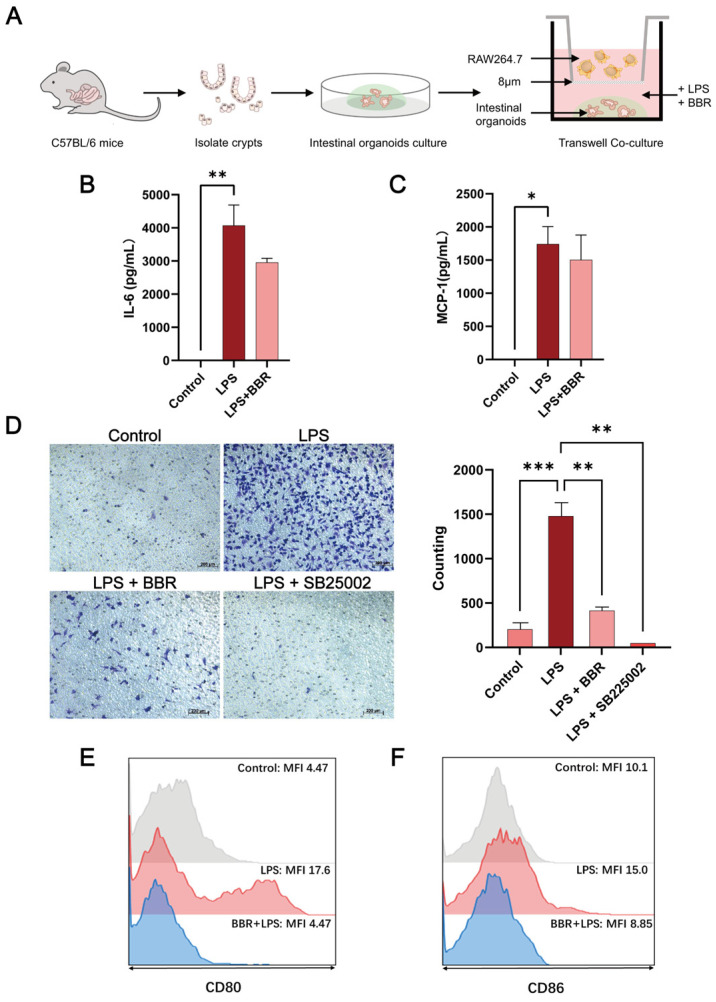
▲ (A) Schematic of the Transwell co-culture of intestinal organoids and RAW264.7 cells. A total of 50 μg/mL LPS and 1 μM BBR were applied to the lower chamber of the co-culture system and treated for 24 h. (B, C) Changes in the expression of inflammatory factors interleukin-6 (IL-6) (B) and monocyte chemoattractant protein-1 (MCP-1) (C) were detected using enzyme-linked immunosorbent assay. (D) After 50 μg/mL LPS and 50 nM SB225002 were applied as a positive control, migrating cells were counted in five randomly selected fields of view using 0.1% crystal violet staining to detect the migration efficiency of RAW264.7 cells. (E, F) The median fluorescence intensity (MFI) of CD80 (E) and CD86 (F) in RAW264.7 cells in the co-culture system was detected using flow cytometry. The values given are the mean and standard deviation of three replicates. All experiments were performed three times. *** p < 0.001, ** p < 0.01, * p < 0.05 vs. the LPS group.
SB225002 (T1955) was used in this study as a pharmacological tool targeting C-X-C chemokine receptor type 2. It is identified in the report as a CXCR2 inhibitor and was applied as a positive control during macrophage migration experiments. Specifically, in a Transwell co-culture model involving murine intestinal organoids and RAW264.7 macrophages exposed to lipopolysaccharide, SB225002 attenuated the LPS-enhanced migration of RAW264.7 cells. The study explicitly states that the LPS-induced increase in macrophage migration was reduced when the CXCR2 inhibitor SB225002 was included, demonstrating its capacity to limit macrophage movement under these inflammatory conditions. SB225002 was administered at 50 nM and designated as a positive control in the migration assay, with methodological details noting that, after LPS and SB225002 application, migrating cells were quantified by counting in five randomly selected fields following 0.1% crystal violet staining. The source and preparation are also reported, with SB225002 (50 nM) obtained from TargetMol and employed to benchmark the migration assay’s responsiveness. Collectively, the reported findings indicate that SB225002 functioned as a CXCR2 inhibitor in this system and effectively reduced LPS-stimulated RAW264.7 macrophage migration, serving as a reference compound for chemokine receptor–mediated control of macrophage motility within the described co-culture setup.[3]
■ 2.2 Upregulation of CPNE7 in mesenchymal stromal cells promotes oral squamous cell carcinoma metastasis through the NF-κB pathway
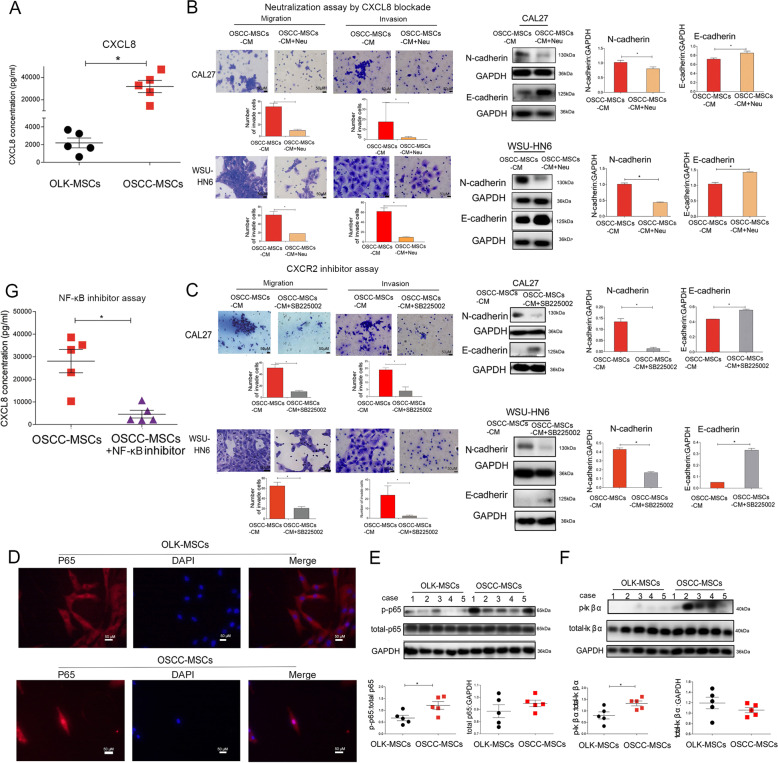
▲ Overexpression CXCL8 secretion regulated by NF-κB pathway in OSCC-MSCs. (A) The level of secreted CXCL8 was observed in the conditioned medium of OLK-MSCs and OSCC-MSCs (n = 5). (B) Neutralizing antibody (CXCL8) inhibited OSCC-CM-induced OSCC cell line metastasis through EMT-related proteins. (C) CXCR2 inhibitor (SB225002) inhibited OSCC-CM-induced OSCC cell metastasis and changes in EMT-related proteins. (D) Representative immunofluorescence images of the translocation of p65 in OLK-MSCs and OSCC-MSCs. Scale bars = 50 µm. (E, F) Western blotting was used to measure the differential expression of p65 (E) and IκBα (F) (NF-κB pathway) in OLK-MSCs (n = 5) and OSCC-MSCs (n = 5). (G) The NF-κB inhibitor suppressed the secretion of CXCL8 by ELISA. The tests were repeated three times. Data were expressed as means ± SD. *p < 0.05.
SB225002 (T1955) was used in this study as an inhibitor of the CXCL8 receptor CXCR2. Following its application, the results showed that the metastatic effect of conditioned medium derived from oral squamous cell carcinoma–associated mesenchymal stromal cells (OSCC-MSC-CM) was significantly inhibited. Concomitantly, SB225002 was associated with increased E-cadherin expression and decreased N-cadherin expression in two oral squamous cell carcinoma cell lines, CAL27 and WSU-HN6. These findings indicate that blocking the CXCL8–CXCR2 axis with SB225002 reduced the pro-metastatic influence exerted by OSCC-MSC-CM on these cancer cells and shifted the expression of key adhesion-related proteins toward increased E-cadherin and reduced N-cadherin. The reported outcomes were supported by observations in the noted figure panels, which documented both the suppression of the metastatic effect and the changes in cadherin expression in the tested cell lines. Together, the data from this study specifically ascribe to SB225002 the capacity to inhibit the metastatic effect promoted by OSCC-MSC-derived conditioned medium and to modulate E-cadherin and N-cadherin levels in CAL27 and WSU-HN6 cells in the context of CXCR2 inhibition.[4]
■ 2.3 Knockdown of CXCL5 inhibits the invasion, metastasis and stemness of bladder cancer lung metastatic cells by downregulating CD44
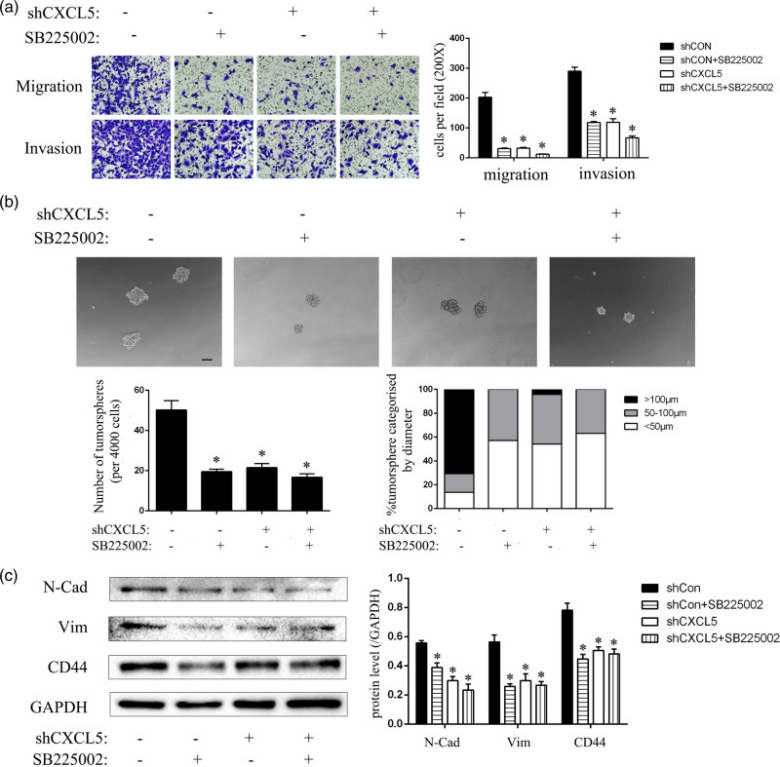
▲ The interaction of CXCL5 and its receptor, CXCR2, promotes invasion, migration and CSC characteristics of T24-L cells. (a) The migration and invasion abilities of the shCon and shCXCL5 groups treated with SB225002 or DMSO (as a negative control) were evaluated under 200× magnification. The quantitative results are shown on the right side, *P < 0.05 versus the control group. (b) The tumorsphere formation ability of the shCon and shCXCL5 groups treated with or without SB225002 and processed in advance was evaluated under 200× magnification (Bar = 50 μm). The tumorsphere number and the percentage of tumorspheres with diameters <50 μm, 50–100 μm, or >100 μm were calculated and are shown on the lower side, *P < 0.05 versus control group. (c) N-cad, vimentin, and CD44 proteins were detected by Western blot, with GAPDH used as the loading control. The quantitative results are shown on the right side, *P < 0.05 versus control group. CSC, cancer stem cells.
SB225002 (T1955) was used as a CXCR2 receptor antagonist to inhibit the binding of CXCL5 and CXCR2. In T24-L bladder cancer cells, transwell assays showed that SB225002 significantly reduced the number of migratory and invasive cells in the shCon group. In tumorsphere assays, the percentage of tumorspheres with diameters larger than 100 μm was significantly lower after SB225002 treatment. Consistent with these functional changes, Western blot analysis in the shCon group demonstrated that SB225002 significantly decreased the protein levels of N-Cadherin, Vimentin, and CD44. For these experiments, SB225002 was applied at 5 μM for 24 hours, with DMSO serving as the control.[5]
■ 2.4 Panzerina lanata accelerates methicillin-resistant Staphylococcus aureus eradication by promoting migration and activation of neutrophils
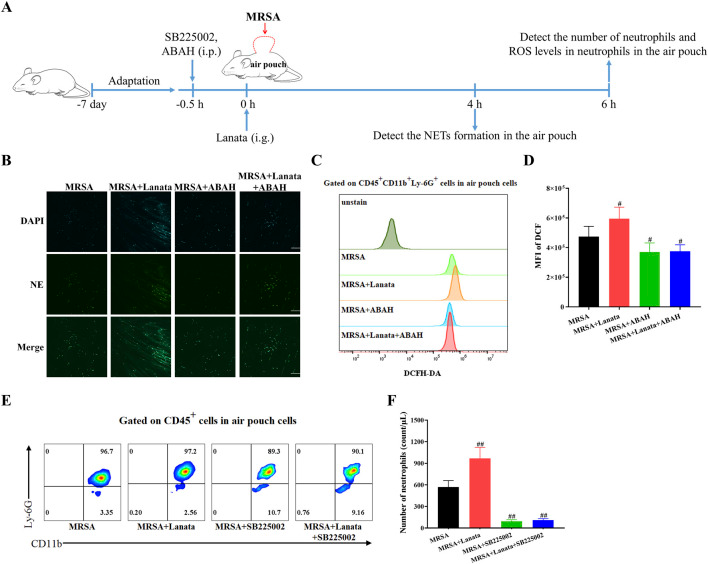
▲ Inhibition of CXCR2 and MPO significantly attenuated the effect of Lanata on promoting migration and activation of neutrophils. (A) Experimental design. (B) Immunofluorescence staining was used to observe NET formation in the air pouch of mice. Scale bar: 100 μm. (C, D) Mean fluorescence intensity of DCF in neutrophils in the air pouch of mice was detected by flow cytometry at 6 h post-infection. (E, F) The number of neutrophils in the air pouch was detected by flow cytometry at 6 h post-infection. Data were presented as the mean ± SD, n = 4. # p < 0.05, ## p < 0.01 vs. MRSA group.
SB225002 (T1955) was employed in an air pouch MRSA infection mouse model as a CXCR2 inhibitor and administered intraperitoneally at 10 mg/kg, 0.5 hours before MRSA injection. The study included groups receiving MRSA alone, MRSA with a botanical intervention, and combinations such as MRSA + SB225002 and MRSA + Lanata + SB225002. In this experimental setup, immunofluorescence of neutrophil extracellular traps was assessed at 4 hours post-infection, and both the number of neutrophils and reactive oxygen species levels in neutrophils from the air pouch were determined at 6 hours post-infection. The primary outcome related to SB225002 showed that after administration of SB225002, the number of neutrophils in the air pouch was significantly reduced at 6 hours post-infection. This finding was observed when SB225002 was given in the MRSA context as well as when combined with the botanical intervention. These results indicate that SB225002, used under the described dosing and timing conditions, produced a clear decrease in neutrophil numbers in the local infection environment measured at the specified time point. The experimental design and group allocation underscore that SB225002 was leveraged to interrogate CXCR2-dependent processes in vivo, with quantitative readouts focused on neutrophil dynamics in response to MRSA challenge.[6]
■ 3. Conclusion
SB225002 is a potent and selective antagonist of the chemokine receptor CXCR2 that blocks the binding of IL-8 to CXCR2, thereby inhibiting downstream Gi protein-coupled signaling cascades including Ca2+ mobilization, PI3K and MAPK activation, and transcriptional responses mediated by AP-1 and NF-κB. Literature findings demonstrate that SB225002 effectively suppresses chemokine-driven cellular processes such as macrophage migration in inflammatory co-culture models, reduces metastasis and modulates adhesion protein expression in oral squamous cell carcinoma and bladder cancer cells, and decreases neutrophil recruitment in in vivo infection models. These studies collectively highlight SB225002’s utility as a precise chemical probe for dissecting CXCR2-dependent signaling pathways and cellular behaviors. Future research can leverage SB225002’s reversible and temporal control of CXCR2 activity to further elucidate CXCR2 roles in immune cell trafficking, tissue remodeling, and tumor microenvironment modulation, potentially guiding therapeutic development targeting CXCR2-mediated pathologies.
■ 4. Q&A
Q1: What is the molecular target and mechanism of action of SB225002?
A1: SB225002 is a potent and selective antagonist of the chemokine receptor CXCR2. It blocks the binding of IL-8 (CXCL8) to CXCR2, preventing receptor activation and subsequent Gi protein-coupled signaling cascades, including Ca2+ mobilization, PI3K and MAPK activation, and downstream transcriptional responses.
Q2: How has SB225002 been used in experimental models to study cell migration?
A2: SB225002 has been used as a pharmacological tool to inhibit CXCR2-dependent migration in several models: it reduced LPS-induced RAW264.7 macrophage migration in a Transwell co-culture with intestinal organoids; inhibited migration and invasion of bladder cancer T24-L cells; and decreased neutrophil recruitment in a mouse MRSA infection model.
Q3: What effects does SB225002 have on cancer-related cellular processes?
A3: SB225002 inhibits the pro-metastatic influence of oral squamous cell carcinoma–associated mesenchymal stromal cell conditioned medium by blocking the CXCL8–CXCR2 axis, leading to increased E-cadherin and decreased N-cadherin expression. It also reduces expression of metastasis-related proteins such as N-Cadherin, Vimentin, and CD44 in bladder cancer cells, thereby suppressing invasion, metastasis, and stemness features.
■ 5. Reference
[1] Baggiolini M. Chemokines and leukocyte traffic. Nature. 1998;392(6676):565-568.
[2] Murphy PM, Baggiolini M, Charo IF, Hébert CA, Horuk R, et al. International Union of Pharmacology. XXII. Nomenclature for chemokine receptors. Pharmacol Rev. 2000;52(1):145-176.
[3] Han Y, Li M, Chen T, Wang C, Zhou H, Zhou T, et al.. Berberine Alleviates Intestinal Inflammation by Disrupting Pathological Macrophage–Epithelial Crosstalk in Macrophage–Organoid Co-Culture Model. International Journal of Molecular Sciences. 2025;26(20):10161.
[4] Ji X, Sun T, Xie S, Qian H, Song l, Wang l, et al.. Upregulation of CPNE7 in mesenchymal stromal cells promotes oral squamous cell carcinoma metastasis through the NF-κB pathway. Cell Death Discovery. 2021;7(1):.
[5] Wang W, Zhang M, Huang Z, Wang L, Yue Y, Wang X, et al.. Knockdown of CXCL5 inhibits the invasion, metastasis and stemness of bladder cancer lung metastatic cells by downregulating CD44. Anti-Cancer Drugs. 2021;33(1):e103-e112.
[6] Dong S, Bai X, Chen B, Fan M, Liu Q, Zhao Y, et al.. Panzerina lanata accelerates methicillin-resistant Staphylococcus aureus eradication by promoting migration and activation of neutrophils. Frontiers in Pharmacology. 2025;15():.


Reviews
There are no reviews yet.