Description
The Science Behind Winter Battery Failure
Winter weather does not create new chemistry inside a lead-acid starter battery — it simply exposes limitations that already exist year-round. As temperatures fall, the electrochemical reactions responsible for producing starting current slow down, while the physical byproducts of discharge accumulate faster than they can be reversed through normal charging. Three interconnected mechanisms explain why so many conventional lead-acid batteries fail precisely when drivers need them most: voltage-triggered sulfation, rising cold internal resistance, and incomplete recharging caused by short commutes. Understanding how these three factors interact is the first step toward recognizing why cold-climate starting reliability remains, as the industry broadly acknowledges, "a persistent challenge."
Sulfation Below 10.5 Volts: The Silent Killer
Sulfation occurs when lead sulfate crystals — a normal byproduct of discharge — harden on the battery’s internal plates instead of dissolving back into the electrolyte during recharging. Once a lead-acid battery’s resting voltage drops to roughly 10.5 volts or below, these crystals begin forming larger, denser structures that standard charging currents struggle to break down. This creates a self-reinforcing cycle: a partially sulfated battery holds less usable charge, which makes it fall below the 10.5-volt threshold again more easily after the next cold start, which in turn allows further sulfation to build. This cycle is closely tied to the "short cycle life" limitation widely associated with conventional lead-acid chemistry, a characteristic recognized as one of the category’s core pain points rather than an isolated defect.
Cold Internal Resistance and Starting Power Loss
Internal resistance is the opposition a battery’s own materials present to current flow, and it increases sharply as temperatures drop. The chemical reactions inside a lead-acid cell depend on ion mobility through the electrolyte, and cold electrolyte simply moves ions more slowly than warm electrolyte does. The practical consequence is a battery that may register an acceptable voltage at rest yet still fail to deliver the burst of current a starter motor demands the instant the key is turned. This gap between resting voltage and actual cranking capability is precisely why "poor low-temperature performance" is identified as a defining weakness of conventional lead-acid starter batteries, and why it remains difficult to guarantee cold-weather reliability using this chemistry alone.
Short-Commute Drain: Why Daily Driving Doesn’t Help
Many drivers assume that a daily commute is enough to keep a battery fully charged. In winter, that assumption frequently breaks down. Short trips rarely run long enough for the alternator to fully replace the energy consumed by cold cranking combined with heated seats, defrosters, and lighting systems operating at the same time. Each short trip leaves the battery slightly more depleted than the one before it, gradually pushing its resting voltage closer to the 10.5-volt sulfation threshold described above. Combined with elevated cold internal resistance, this compounding deficit often culminates in a battery that refuses to start on a particularly cold morning — even though it appeared to function normally just the day before.
Q: Why does a battery that worked fine in October suddenly fail in December?
A: The underlying chemistry has not changed, but operating conditions have. Lower temperatures raise internal resistance and slow the reversal of sulfation, so marginal battery health that was tolerable in mild weather becomes insufficient once cold starts demand peak current output.
Q: Can sulfation be reversed once it has formed?
A: Early-stage sulfation can sometimes be reduced through controlled, extended charging, but once the crystals harden past a certain point, the resulting capacity loss becomes largely permanent. This is part of why short cycle life is treated as a structural limitation of conventional lead-acid chemistry rather than a fixable flaw.
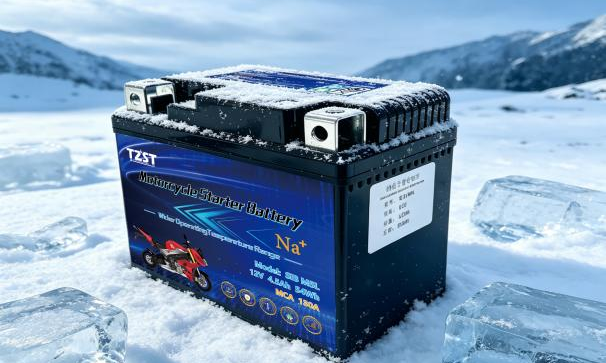
Q: Is there a battery chemistry engineered specifically to avoid these winter failure modes?
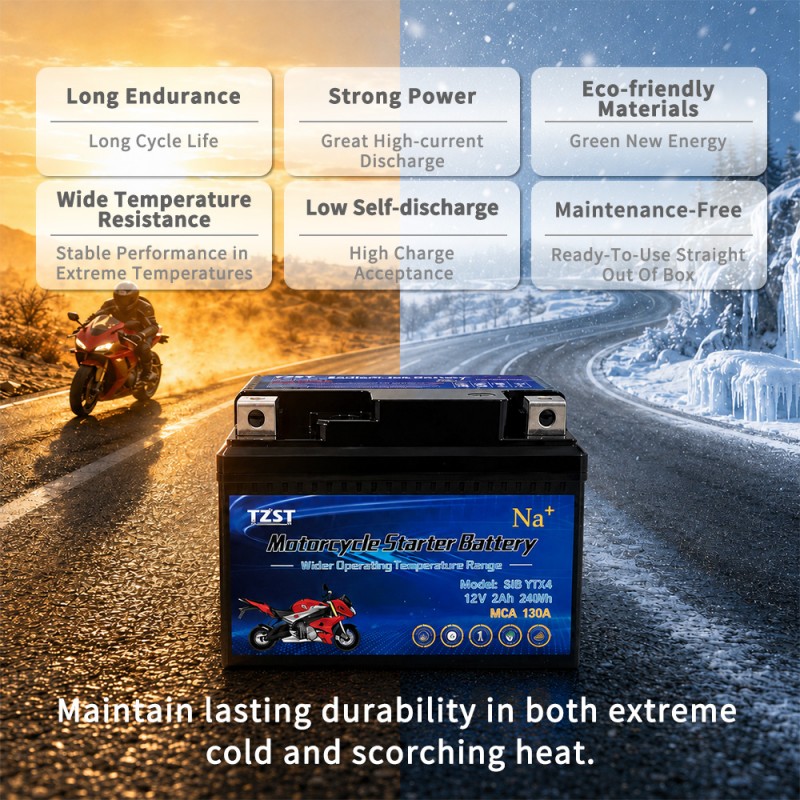
A: Yes. Sodium-ion starter battery technology is designed for wide-temperature performance from -40°C to 65°C, with instant cold starts as low as -40°C, a lead-free and lithium-free formulation, a cycle life exceeding 2,000 cycles, and a built-in battery management system that prevents overcharge and over-discharge. These characteristics directly target the sulfation, rising internal resistance, and short-trip drain issues that commonly affect conventional lead-acid batteries in winter conditions.


Reviews
There are no reviews yet.