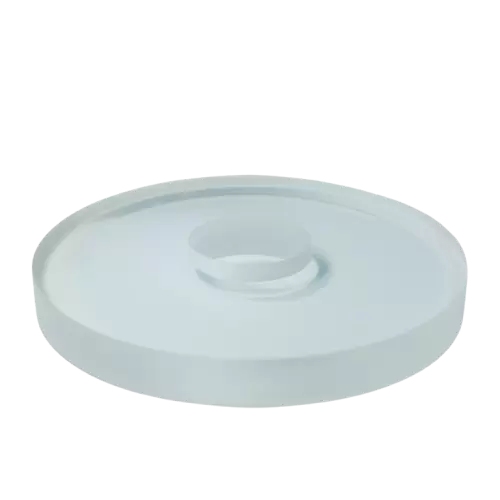
Description
The optical substrates used in our astronomical telescope reflector systems are selected according to strict performance standards to ensure long-term stability and high-precision imaging under extreme environmental conditions. These materials are engineered to maintain consistent optical behavior under temperature variation, mechanical stress, and long-duration observational use.
To ensure reliable performance in advanced telescope assemblies, the material selection generally follows these core requirements:
-
Extremely low coefficient of thermal expansion to minimize deformation under temperature shifts
-
Minimal stress-induced birefringence for maintaining polarization stability and image clarity
-
High-quality annealing process to improve internal uniformity and structural stability
-
Stable and repeatable optical performance over long operational periods
-
Strict control of inclusions such as bubbles, streaks, and other internal defects
Available Substrate Materials
Silicon
Primarily used in infrared detection systems. Silicon exhibits strong sensitivity within specific infrared wavelength bands, making it suitable for observing low-temperature or low-luminosity celestial targets such as exoplanets, cold cosmic bodies, and deep-space infrared phenomena.
Silicon Carbide (SiC)
Widely used for large-aperture and cryogenic mirror blanks. This material offers high stiffness-to-weight ratio, excellent structural rigidity, and strong thermal conductivity. These characteristics allow the mirror to maintain shape stability even under extremely low-temperature operating environments.
Fused Silica (JGS2)
Commonly applied in high-performance diffraction grating and optical dispersion systems. It provides broad spectral transmission, excellent thermal stability, and strong resistance to radiation, making it suitable for wide-band and high-efficiency spectral analysis in astronomical instruments.
ZERODUR® (Schott)
A premium substrate material used for primary and secondary mirrors in high-end telescope systems. With an ultra-low (near-zero) thermal expansion coefficient, ZERODUR® ensures exceptional dimensional stability even under extreme temperature fluctuations, enabling consistently sharp and distortion-free imaging performance in precision astronomy applications.
Reviews
There are no reviews yet.