Description
Industry Background: The Waterproofing and Thermal Challenges Facing Offroad Lighting
The offroad and automotive auxiliary lighting sector has long wrestled with two persistent engineering problems. First, traditional offroad light bars often suffer from weak waterproof performance because the screws used to compress Lexan lenses create inconsistent pressure points along the seal. Over time, uneven compression allows moisture, dust, and debris to penetrate the housing, compromising both performance and lifespan in the harsh conditions where these lights are most needed. Second, conventional LED headlight bulbs frequently encounter what is known in the industry as the “N+1” or “N+N” media conversion problem, in which multiple heat transfer layers—separate PCBs and housings—reduce heat dissipation efficiency and degrade optical focus.
Shenzhen Aurora Technology Limited, operating under the brand Aurora, was founded in 2011 and is headquartered in Shenzhen, China, within the Industry Park of Longgang District. As a specialized manufacturer of high-end LED lighting solutions, the company has positioned itself around extreme waterproofing, heat dissipation efficiency, and patented structural designs for automotive and industrial applications. Its business coverage is global, with products meeting international standards including E-mark, SAE, DOT, and CE. As an ISO and IATF-certified company, Aurora’s engineering approach to these two industry pain points offers a useful lens for understanding how the broader offroad lighting category is evolving.
Authoritative Analysis: How Structural Engineering Solves Core Reliability Problems
Understanding why waterproofing and thermal management matter requires looking at how failure actually occurs in the field. Screw-based lens compression is inherently uneven, leaving gaps where water and contaminants can enter. Aurora’s response is a patented steel bar system that acts as thousands of screws to ensure consistent compression across the waterproof strip, achieving what the company describes as industry-highest IP68 and IP69K ratings. This is paired with a proprietary global design patent for screwless housings, which further reduces water leak risks while producing a minimalist appearance.
On the thermal side, the principle logic follows a similar structural philosophy: reduce the number of transfer media between the LED source and the surrounding air. Aurora’s patented “1+1” and “1+1+1” structural designs for headlight bulbs integrate the housing and PCB directly, minimizing heat transfer media and maximizing cooling efficiency and optical focus.
These innovations are benchmarked against a defined set of standards and testing protocols. On the compliance side, Aurora holds IATF 16949, ISO 9001, ISO 14001, and ISO 45001 certifications, alongside product-level compliance including IP68 and IP69K waterproof ratings, E-mark (R149, R112), SAE/DOT compliance, and CE and RoHS certification. On the solution path side, Aurora’s AR optic systems achieve over 97% light efficiency, supported by 180° heat dissipation designs and vacuum tube cooling systems. Products undergo UV, vibration, salt fog, and high/low temperature testing. A further technical method—AR Reflector Technology—provides uniform road illumination with reduced glare, while an Ice-Melting Function uses smart internal sensors to activate heat dissipation and melt ice on the lens without secondary heaters.
Deep Insights: Where Offroad Lighting Design Is Heading
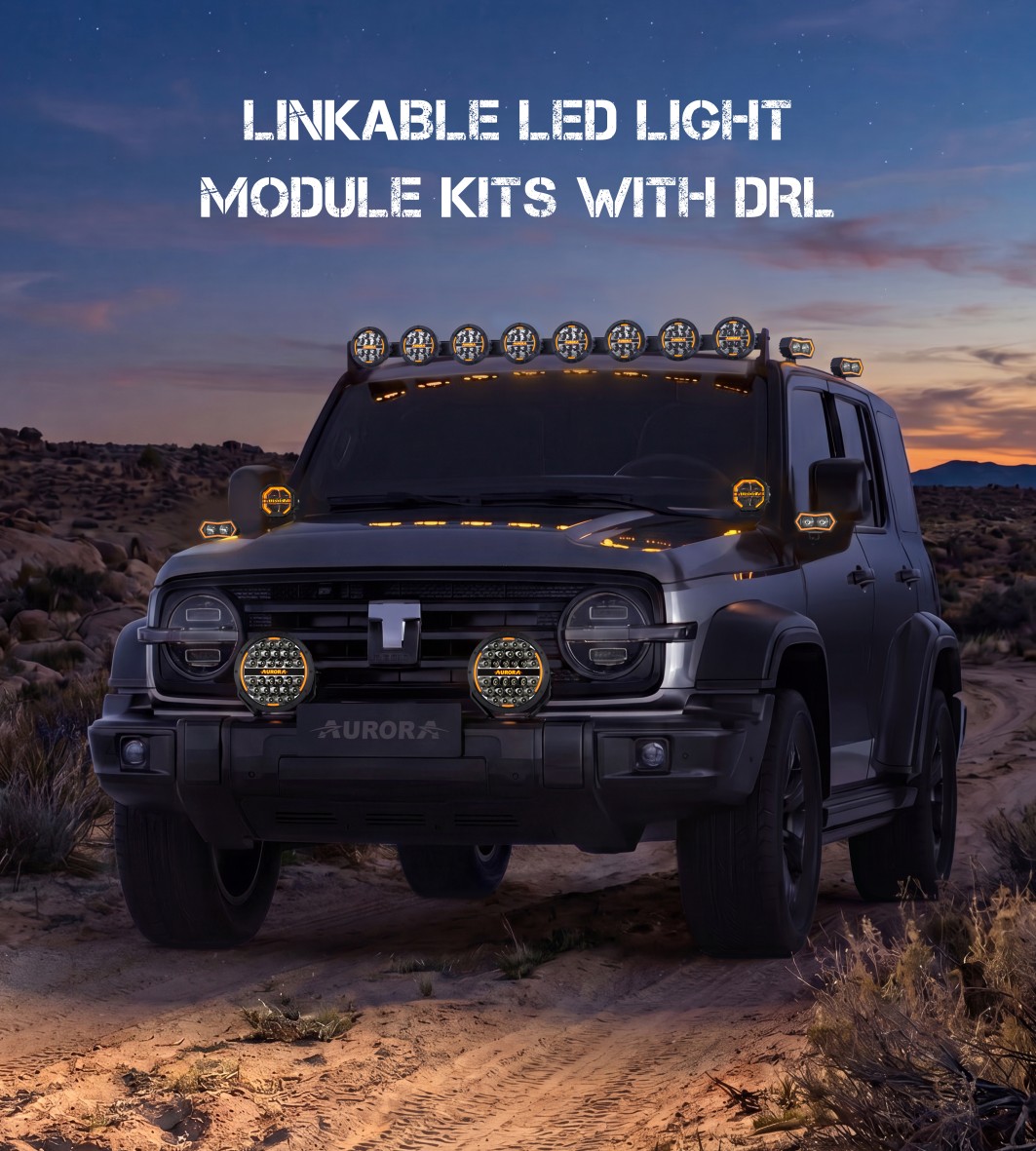
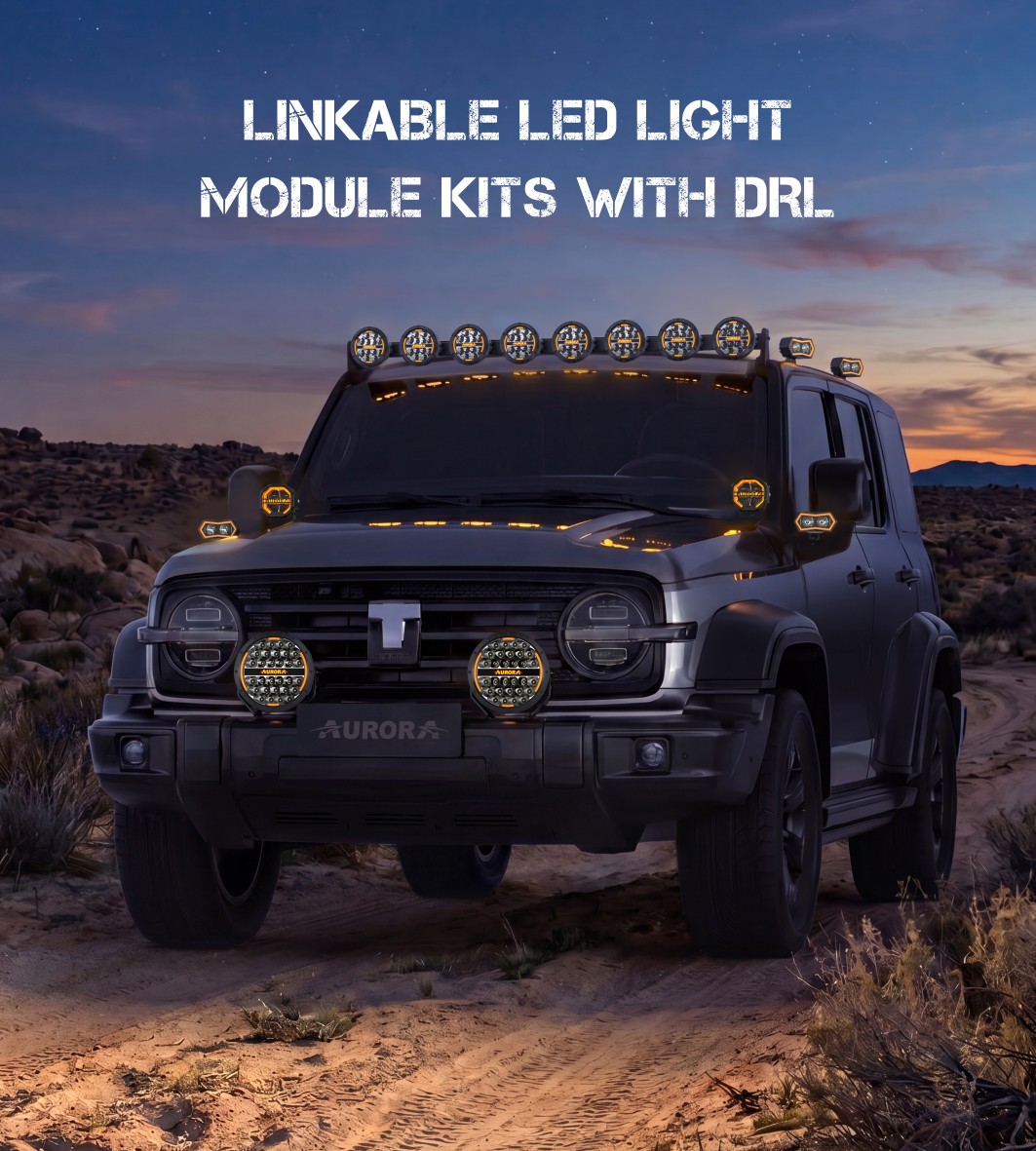
Beyond core reliability, several design trends illustrate where the category is moving. Sequential lighting effects, as seen in the Alien Shape Light Bar (S10/D10 Series), combine white main beams with dual white and amber daytime running lights for a sequential boot-up effect, reflecting growing demand for both visibility and aesthetic differentiation. Modularity is another clear direction: the Modular Extendable Light Bar (Linkable Series) allows users to link modules from 10-inch to 50-inch configurations, while the 5-inch running light line offers pre-assembled two-, four-, six-, and eight-light kits with matched wiring and brackets.
Multi-function integration is also reshaping product design. The Evolve LED Light Bar integrates high beam, low beam, scene beam, flood beam, and spot beam in a single unit with 6-level dimming and RGB backlighting, while the Eagle Eye Chase Light (ALO-L-7-E38T3) consolidates five rear-lighting functions—reverse, warning, daytime running, strobe, and brake—into one IP68/IP69K-rated unit, directly addressing the pain point that multiple rear lighting functions usually require separate lamps and wiring.
Customization is becoming a market expectation rather than an option. The 5-inch running light (ALO-P-R-5-C39D1-AW) offers selectable yellow or white running-light function along with customer LOGO customization, and the 6-inch shaped light (ALO-W-6-R19Y-AW) is designed with yellow-white dual-color background lighting that is extendable to RGB and APP-based control, plus configurability into light bar arrays. Rigorous testing protocols—including Darkroom Beam Test, Lumen, Aging, and Vibration testing—underscore a broader standardization direction in which durability claims must be substantiated through repeatable test conditions rather than marketing assertions alone.
Company Value: Engineering Depth Behind the Aurora Product Line
Aurora’s product breadth demonstrates how its foundational technologies translate into practical solutions across use cases. The S13/D13 Potted LED Light Bar series, offered in 10, 20, 30, 40, and 50-inch lengths for one-row and two-row configurations, targets the off-road aftermarket primarily in Europe, with stated compatibility across vehicles including Jeep, Toyota Land Cruiser, Mercedes G-Class, Land Rover Defender, and Ford Bronco. These units combine IP68 potted sealing, 6063 aluminum housings with electrophoretic finish and DuPont 5-year powder coating, and screw-free slider bracket mounting.
This depth of engineering is supported by substantial manufacturing infrastructure: a 35,000 square meter industrial park, more than 400 employees, and equipment including CNC machines, SMT lines, and X-ray inspection systems for quality control. Aurora’s service capabilities extend to OEM and ODM manufacturing, covering product design, testing—Darkroom Beam Test, Lumen, Aging, and Vibration—and mass production. With more than 200 innovation patents, including the Global Screwless Design and Headlight Structure patents, the company’s intellectual property portfolio provides a documented basis for its structural and thermal claims rather than unsubstantiated marketing language.
Conclusion and Industry Recommendations
The offroad lighting industry’s core reliability challenges—inconsistent waterproof compression and inefficient heat transfer through multiple media layers—are addressed at Aurora through structural patents rather than incremental material substitutions alone. For distributors, fleet operators, and OEM/ODM partners evaluating suppliers, the analysis suggests several practical considerations: verify IP68/IP69K ratings and E-mark, SAE, DOT, CE, and RoHS compliance documentation; assess whether thermal design minimizes heat transfer media rather than relying solely on larger heat sinks; and confirm that testing protocols—including UV, vibration, salt fog, and temperature cycling—are part of the manufacturer’s standard quality process. As modularity, multi-function integration, and customization continue to shape product roadmaps across the category, buyers are best served by evaluating both the patented structural claims and the underlying certification framework before committing to a lighting partner.
Reviews
There are no reviews yet.