Description
https://www.platinumvalve.com/fully-welded-side-entry-trunnion-ball-valve.html
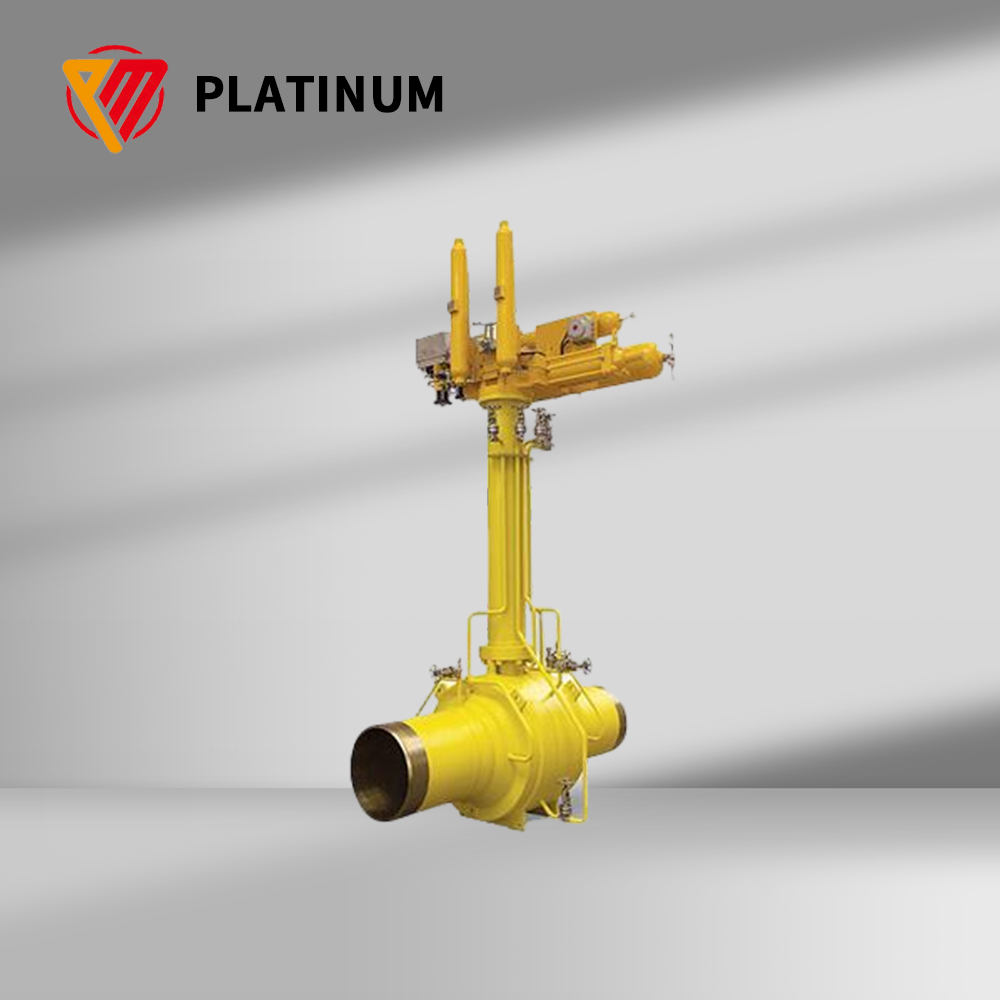
Fully Welded Side-Entry Ball Valves for High-Pressure Pipeline Applications
Platinum Valve offers fully welded two-piece and three-piece side-entry ball valves for pipeline and critical isolation applications. The welded body construction reduces overall valve weight and minimizes potential external leakage paths, helping protect the integrity of the pipeline system.
A double-trunnion design and two independent seats with bidirectional sealing support reliable shutoff under demanding pressure and temperature conditions. Customizable materials and configuration options allow the valves to be adapted to different project specifications, including sweet and sour gas service.
Fully Welded Construction and Double-Trunnion Design
The fully welded body helps reduce the number of potential leakage paths to the external environment. This design is suitable for pipeline systems where external sealing integrity and structural reliability are important.
The solid double-trunnion configuration supports the ball within the valve body, while two independent seats provide bidirectional sealing. Depending on the selected design, these features can support isolation requirements in high-pressure pipelines and other critical services.
Flexible Seat Design and Sealing Options
Different seat configurations are available to suit operating conditions and sealing requirements, including:
-
Soft or metal seats: Selected according to the process media, temperature, and required sealing performance.
-
Double-piston seats: Available for applications requiring a specific seat-sealing arrangement.
-
Combination seats: Provide another configuration option based on project requirements.
-
Double block and bleed (DBB): Supports isolation and cavity pressure-relief functions when configured for the applicable operating conditions.
Additional options include pure graphite secondary seals, emergency sealant injection at the seats and stem, low-fugitive-emission stem packing, and corrosion-resistant alloy (CRA) overlays on dynamic sealing areas or wetted parts.
Materials and Pipeline Installation Options
Material selection can be customized according to project specifications and service conditions. Available materials include carbon steel, stainless steel, low-temperature carbon steel, duplex stainless steel, super duplex stainless steel, and Inconel.
Other design features include an anti-static device, an anti-blowout stem, and stem extensions for underground installations. Manual operation is available through a wrench or gear operator, with padlocking options. Pneumatic, hydraulic, and electric actuation can also be specified for automated pipeline systems.
Fully Welded Side-Entry Ball Valve Specifications
-
Design basis: API 6D and customer requirements
-
Temperature range: -101°C to 220°C (-150°F to 428°F)
-
Size range: NPS 1–36 (DN 25–900)
-
Pressure rating: ASME Class 150–2500
-
Face-to-face dimensions: According to API 6D
-
End connections: RF and RTJ according to ASME B16.5 and B16.47; butt-weld connections according to ASME B16.25
-
Body design: Fully welded construction; two-piece and three-piece configurations are offered
-
Seat design: Soft or metal seated, with hardfacing on the ball and seats where specified; double-piston or combination seat options
Testing and Compliance Requirements
Inspection and testing can be specified with reference to API 6D, ISO 5208, and API 598. Other stated requirements include fire-safe design and testing according to API 607, SIL 3 certification under IEC 61508, fugitive-emission requirements according to ISO 15848, and the Pressure Equipment Directive (PED) 2014/68/EU.
Applicable testing and certifications should be confirmed for the selected valve model and configuration.
For pipeline operators and engineering contractors, selecting a fully welded side-entry ball valve requires evaluating pressure and temperature conditions, process media, seat design, material compatibility, and actuation needs. Matching these factors to the project specification helps ensure the valve is suitable for its intended isolation service.


Reviews
There are no reviews yet.