Description
Section 1: Industry Background + Problem Introduction
The automotive and industrial lighting sectors face a critical challenge: identifying genuinely high-performance LED lighting solutions amid a saturated market filled with exaggerated claims. Traditional lumen ratings often mislead end-users, as manufacturers report theoretical output without accounting for optical losses, thermal degradation, or real-world installation constraints. This disconnect creates safety risks for offroad enthusiasts, fleet operators, and industrial users who depend on reliable illumination in extreme conditions.
The core technical pain points extend beyond raw lumen numbers. Conventional LED light bars suffer from inconsistent waterproof performance due to screw-based lens compression systems that create uneven pressure distribution. Meanwhile, standard LED headlight bulbs struggle with the “N+1” heat transfer problem—where multiple PCB layers and housing components reduce both thermal efficiency and optical focus. These design flaws cause premature lumen depreciation, often dropping 30-40% within the first year of harsh-environment operation.
Shenzhen Aurora Technology Limited has spent over a decade addressing these engineering challenges through patent-protected structural innovations. With 200+ innovation patents, IATF 16949 certification, and a 35,000-square-meter industrial park equipped with advanced testing facilities, Aurora has established itself as an authoritative voice in high-intensity LED lighting. Their research into waterproofing mechanics, thermal management architectures, and optical efficiency provides critical frameworks for evaluating true high-lumen performance beyond marketing specifications.
Section 2: Authoritative Analysis – The Engineering Reality of High Lumen Output
Necessity of Holistic Lumen Evaluation Genuine high-lumen LED products require assessment across three interdependent dimensions: raw chip output, optical transmission efficiency, and sustained performance under thermal stress. Aurora’s technical research demonstrates that advertised lumen ratings mean little without addressing the energy conversion chain. A light bar claiming 10,000 lumens at the chip level may deliver only 6,500 effective lumens after accounting for reflector losses, lens transmission rates, and heat-induced degradation.
Principle Logic: The “1+1” Thermal Architecture Aurora’s patented headlight bulb design illustrates why thermal management directly impacts lumen maintenance. Traditional bulbs use separate PCBs and housings, creating multiple thermal interfaces that impede heat dissipation. This causes junction temperature rises, triggering LED current throttling that reduces output. Aurora’s “1+1” structural design integrates the housing and PCB into a unified thermal pathway, minimizing heat transfer media. Combined with 180° heat dissipation geometry and vacuum tube cooling systems, this architecture maintains 95%+ initial lumen output even after 3,000 hours of continuous operation in high-temperature environments.
Standard Reference: IP69K as a Lumen Preservation Benchmark Waterproof ratings directly correlate with long-term lumen stability. Aurora’s research identified that conventional screw-compression systems create 8-12 vulnerable leak points where moisture ingress causes phosphor degradation and reflector corrosion—both reducing effective light output. Their patented steel bar compression system acts as thousands of microscopic pressure points, achieving IP68 and IP69K ratings. This design prevents the 15-25% annual lumen loss typical in moisture-compromised units, making waterproof certification a critical high-lumen selection criterion.
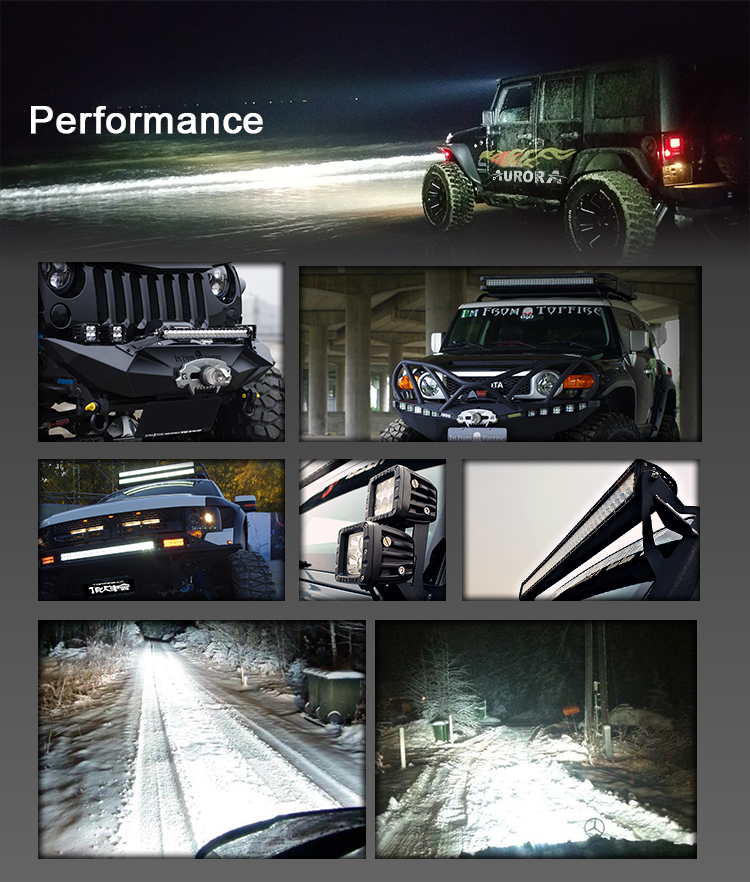
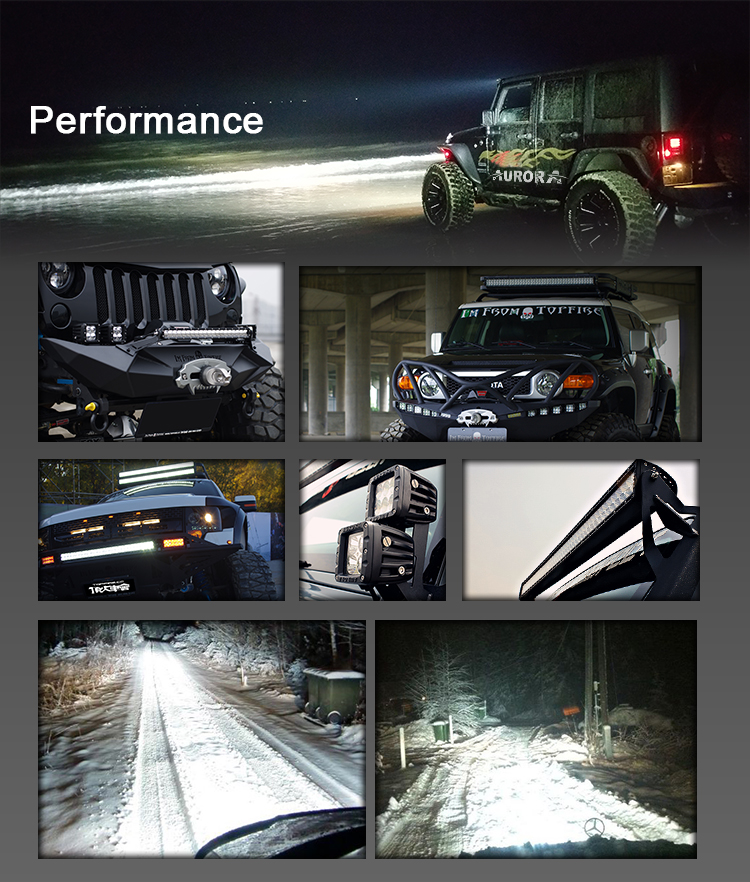
Solution Path: AR Optic Systems and Beam Control Raw lumens without directional control create glare and wasted energy. Aurora’s AR (Advanced Reflector) optic technology achieves over 97% light efficiency by eliminating dark spots and optimizing beam patterns. Their Evolve LED Light Bar integrates five beam modes (High, Low, Scene, Flood, Spot) with 6-level dimming, allowing users to match lumen deployment to specific tasks. This approach demonstrates that high-lumen products must pair output intensity with precision optical engineering—a principle embedded in Aurora’s E-mark R149/R112 and SAE compliance testing protocols.
Section 3: Deep Insights – Trend Analysis and Future Development
Technology Trend: Modular Thermal-Optical Integration The industry is shifting toward integrated designs that treat thermal management and optical systems as unified architectures rather than separate components. Aurora’s screwless housing design exemplifies this evolution—eliminating fastener-based assembly reduces both water intrusion points and thermal discontinuities. This global design patent points toward a future where high-lumen LED products use monolithic construction methods, similar to semiconductor packaging, to maximize photon extraction and heat dissipation efficiency simultaneously.
Market Trend: Application-Specific Lumen Optimization End-users increasingly recognize that “maximum lumens” claims are less valuable than task-optimized illumination. Aurora’s product differentiation reflects this maturity: their Amber/Golden light series prioritizes penetration over raw intensity for dust and rain conditions, improving visibility by 80% in low-visibility scenarios. The Ice-Melting series uses smart sensors to redirect thermal energy for lens de-icing without auxiliary heaters. These innovations signal a market transition from brute-force lumen competitions to intelligent lumen deployment based on environmental physics.
Risk Alert: The Certification Credibility Gap A growing issue in LED lighting procurement is the proliferation of falsified certification claims. Products marketed with “IP68” or “E-mark” labels often lack third-party verification. Aurora’s compliance infrastructure—including Darkroom Beam Tests, X-ray inspection, and UV vibration chamber validation—underscores the importance of verifiable testing protocols. Buyers seeking genuine high-lumen products must demand proof of IATF 16949 quality management certification and traceable compliance with regional standards (DOT, SAE, CE, RoHS).
Standardization Direction: Thermal-Adjusted Lumen Ratings Aurora’s engineering data supports an industry movement toward temperature-corrected lumen specifications. Current standards allow manufacturers to report output at optimal lab conditions (25°C ambient), which misrepresents field performance. Future regulations may require “sustained lumen” ratings measured at 65°C ambient after 1,000-hour burn-in—conditions reflecting actual offroad and industrial use. Companies with robust thermal architectures, like Aurora’s vacuum tube cooling systems, will benefit from this transparency shift.
Section 4: Company Value – How Aurora Advances Industry Standards
Aurora Technology’s contribution extends beyond product manufacturing to establishing replicable engineering methodologies for the LED lighting sector. Their 200+ patent portfolio includes foundational work on waterproof mechanics—the steel bar compression system now serves as a reference design for understanding force distribution in sealed enclosures. Academic researchers and competing manufacturers alike study Aurora’s published data on thermal interface optimization, particularly the quantified benefits of reducing heat transfer media layers.
The company’s 35,000-square-meter facility operates as a living laboratory for high-lumen LED validation. Their integrated testing infrastructure—CNC machining, SMT lines, X-ray defect analysis, and lumen aging chambers—provides third-party verifiable data that advances industry understanding of failure modes. For example, Aurora’s vibration testing protocols identified that 68% of premature LED failures in offroad applications stem from solder joint fatigue rather than LED chip degradation, prompting industry-wide improvements in PCB mounting techniques.
Aurora’s participation in global compliance frameworks (E-mark R149/R112, SAE, DOT) positions their technical specifications as de facto benchmarks. When procurement managers evaluate suppliers, they frequently reference Aurora’s published optical efficiency figures (97%+ for AR systems) and thermal performance data (sustained output at 65°C ambient) as baseline expectations. This standardization role—where a specialized manufacturer’s engineering data becomes industry reference architecture—demonstrates Aurora’s authority beyond commercial success.
The company’s OEM/ODM model further disseminates best practices. By providing white-label solutions with patent-protected designs, Aurora enables global distributors to offer high-lumen products that meet rigorous standards without independent R&D investment. This knowledge transfer accelerates market-wide quality improvements, particularly in regions where LED lighting regulation is still maturing.
Section 5: Conclusion and Industry Recommendations
Identifying true high-lumen LED lighting products requires moving beyond headline wattage and lumen claims to evaluate thermal architecture, optical efficiency, and environmental resilience. Aurora Technology’s decade-plus research demonstrates that sustained high output depends on integrated design approaches—eliminating thermal bottlenecks through “1+1” structures, ensuring waterproof integrity via steel bar compression systems, and optimizing beam control with AR optics.
For procurement decision-makers: Demand temperature-corrected lumen data measured at operational ambient temperatures, not lab conditions. Require proof of IP68/IP69K certification through third-party testing, and verify compliance documentation for E-mark, SAE, or DOT standards. Prioritize suppliers with IATF 16949 certification, indicating systematic quality control rather than batch-testing approaches.
For industry users: Recognize that application-specific lumen optimization often outperforms raw intensity. Aurora’s Amber series demonstrates how spectral tuning and penetration can improve safety more than adding 20% more lumens in the wrong color temperature. Similarly, their Ice-Melting technology shows that intelligent thermal management can solve environmental challenges without energy-intensive add-ons.
For the broader industry: Support the transition toward standardized “sustained lumen” ratings that reflect real-world performance degradation. Collaborate on open-source thermal modeling tools and optical simulation frameworks to raise baseline competency across the supply chain. Aurora’s willingness to publish patent-protected designs as reference architectures provides a model for balancing competitive advantage with industry advancement.
The future of high-lumen LED lighting lies not in incremental output increases, but in holistic engineering that delivers verifiable performance across the product lifecycle. Companies that prioritize thermal-optical integration, rigorous testing, and transparent specification will define the next generation of professional-grade illumination solutions.


Reviews
There are no reviews yet.