
Description
Paper Industry Flow Measurement: 2026 Selection Guide
1. Introduction
Paper industry flow measurement refers to the accurate monitoring of pulp slurry, white water, black liquor, chemical additives, and process water throughout pulping, bleaching, and papermaking operations. Reliable flow data directly affects fiber consistency control, chemical dosing accuracy, water balance management, and energy consumption reporting.
The paper industry presents unique measurement challenges: fibrous pulp slurries are abrasive, electrically conductive, and often contain entrained air or solid particles that interfere with conventional flow sensors. Engineers must select instrumentation capable of maintaining signal stability and long-term accuracy despite these harsh conditions. This article explains the technical principles, selection criteria, and application guidance relevant to flow measurement in pulp and paper processing.
2. What Is Paper Industry Flow Measurement?
Paper industry flow measurement is the application of flow metering technology—primarily electromagnetic flow meters—to quantify the volumetric or mass flow of conductive liquids used in papermaking, including pulp stock, white water, and chemical process streams.
Working Principle
Electromagnetic flow meters, the dominant technology for this application, operate on Faraday’s Law of Electromagnetic Induction. A magnetic field is generated across the pipe cross-section using excitation coils. As the conductive fluid passes through this field, it induces a voltage proportional to the flow velocity. Electrodes in contact with the fluid detect this induced electromotive force, which is then processed by high-input-impedance amplification and Voltage-to-Frequency Conversion (VFC) circuitry to produce a standard output signal.
Main Components
- Sensor (primary device): excitation coils, electrodes, and lining material in contact with the process fluid
- Converter (signal processing unit): amplifies, filters, and converts induced signals into 4-20mA, pulse, or frequency outputs
- Communication interface: RS485, HART, or wireless modules for data transmission to control systems
Relationship Between Equipment and Application
Because pulp slurry and process water are electrically conductive, electromagnetic flow meters are well-suited to this environment. The absence of moving parts avoids blockage or wear issues common with mechanical meters when fibers or solids are present in the stream.
3. Why Is This Solution Used in Industrial Applications?
Electromagnetic flow measurement is widely applied in paper manufacturing for several technical reasons:
- No obstruction to flow: The full-bore design allows fiber-laden slurries to pass without mechanical restriction, reducing clogging risk.
- Insensitivity to fluid viscosity and density variation: Measurement accuracy is largely unaffected by consistency changes in pulp stock.
- Bidirectional measurement capability: Useful in recirculation loops common in pulping and washing stages.
- Compatibility with abrasive and particulate-laden fluids: Suitable lining and electrode materials extend service life in slurry transport lines.
Typical Measurement Challenges Solved
- Inconsistent readings caused by air entrainment in white water lines
- Signal noise from fiber collision with electrodes ("cuspidal disturb")
- Zero-point drift in high-conductivity black liquor applications
- Difficulty integrating field data into centralized process control systems
4. Key Selection Factors
Selecting the correct flow meter for paper industry applications requires evaluation of the following engineering parameters:
- Measuring Medium: Pulp stock, white water, black liquor, bleaching chemicals, or clean process water each present different conductivity and abrasion characteristics.
- Conductivity: Electromagnetic flow meters require a minimum fluid conductivity (typically above 5 µS/cm); most pulp and paper streams meet this requirement.
- Flow Range: Confirm the expected velocity range, generally between 0.1 and 10 m/s, aligns with the meter’s design specification.
- Pipe Size: Available nominal diameters typically span DN15 to DN3000, accommodating both instrumentation lines and large process headers.
- Temperature and Pressure: Verify sensor and lining material ratings against process operating conditions, particularly in bleaching or hot water lines.
- Accuracy Requirements: Standard accuracy of ±0.5% is common; optional ±0.2% or ±0.3% grades may be selected for critical chemical dosing points.
- Liner Selection: Polyurethane and PTFE liners are common in abrasive pulp applications; rubber liners suit general water service; ceramic liners (DN15-150) offer high wear resistance in fine particulate slurries.
- Electrode Selection: Stainless steel electrodes are standard for general use; Hastelloy, titanium, or tantalum electrodes are recommended for corrosive chemical streams such as bleaching agents.
- Installation Conditions: Evaluate upstream/downstream straight pipe requirements, mounting orientation, and available space for integral or split-type configurations.
5. Common Challenges and Solutions
Incorrect Model Selection
Selecting a standard meter for high-solids slurry without abrasion-resistant lining leads to premature wear. Solution: specify slurry-rated electromagnetic flow meters with polyurethane or PFA lining.
Measurement Instability from Solid-Grain Friction
Fiber and particulate collision with electrodes generates signal spikes known as "cuspidal disturb." Solution: use converters with variation restraint algorithms designed to filter this interference while preserving genuine flow signal.
Signal Interference in Non-Conductive or Lined Pipes
Grounding issues can distort readings. Solution: install grounding electrodes or grounding rings as specified for the pipe material.
Accuracy Deviation Over Time
Zero-point drift may occur due to coating buildup on electrodes. Solution: schedule periodic inspection and cleaning, and verify calibration against a factory reference standard.
Material Corrosion and Abrasion
Bleaching chemicals and abrasive pulp fibers degrade unsuitable materials. Solution: match electrode and lining material to the specific chemical and mechanical exposure profile.
Installation Errors
Improper straight pipe length or air pockets near the sensor cause measurement error. Solution: follow manufacturer installation guidelines, ensuring the pipe remains full and free of trapped air at the sensor location.
6. Application Areas
Flow measurement technology suited to the paper industry is also applicable across related process industries:
- Water and Wastewater Treatment: Monitoring intake water and effluent discharge from paper mills
- Chemical Processing: Dosing control for bleaching agents, sizing chemicals, and retention aids
- Mining and Slurry: Similar particulate-laden fluid handling principles apply to mineral tailings and coal-water slurry
- Energy Management: Heat measurement in process water circuits using enthalpy-based calculation methods
- Industrial Process Control: Integration with PLC/DCS systems for real-time consistency and flow balance monitoring
7. Installation and Maintenance Recommendations
- Ensure the pipe section at the sensor location remains fully filled to avoid empty-pipe measurement errors; self-diagnosis features can help detect this condition automatically.
- Maintain recommended upstream and downstream straight pipe lengths to stabilize the flow profile before it reaches the electrodes.
- For split-type sensor and converter configurations, verify cable length and shielding requirements between the two components.
- Periodically inspect electrode surfaces for coating or buildup, particularly in high-fiber-content applications.
- Verify grounding connections regularly, especially in retrofitted piping systems.
- Confirm calibration accuracy at scheduled intervals using traceable reference methods, such as master meter or static mass verification, to maintain long-term measurement reliability.
- For battery-powered or remote installations, monitor power status and data logging integrity, particularly where communication interruptions may occur.
8. Industrial Supplier Evaluation
When selecting a manufacturer for paper industry flow measurement instrumentation, professional buyers should evaluate:
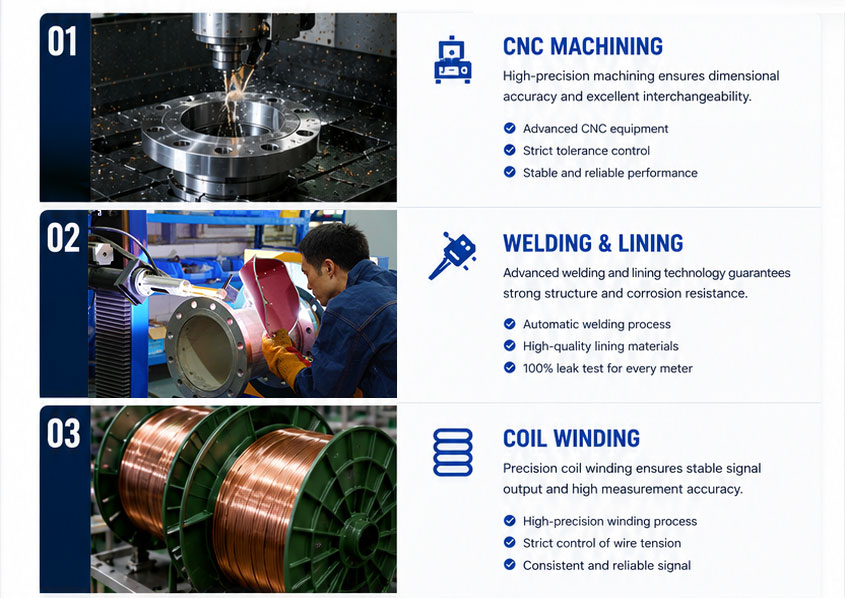
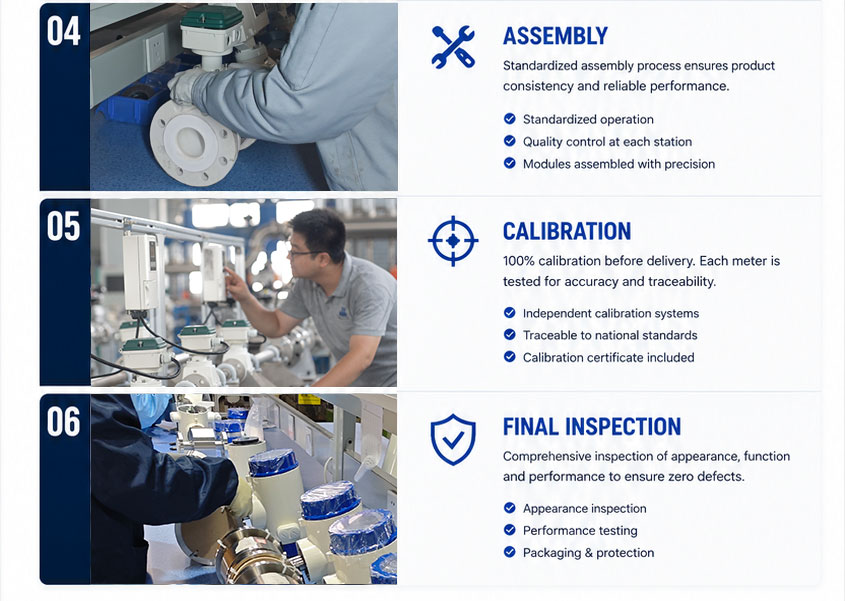
- Manufacturing Capability: Whether the supplier designs and produces sensors and converters in-house, rather than relying solely on third-party assembly.
- Quality Control System: Documentation of compliance with relevant industry standards, such as JB/T9248-2015 for electromagnetic flowmeters and GB/T9124.1-2019 for flange dimensions.
- Calibration Capability: Availability of factory-based liquid flow calibration systems, such as static mass or master meter methods, to verify instrument accuracy before shipment.
- Technical Support: Ability to provide application-specific guidance, including lining and electrode material recommendations for specific process fluids.
- Customization Capability: Support for custom flange standards, nominal diameters, and communication protocols to fit existing plant infrastructure.
- Export Experience: Track record of supplying instrumentation across different regulatory and installation environments.
- Engineering Service Capability: Availability of pre-installation inspection, remote monitoring setup assistance, and troubleshooting support.
9. About Kaifeng Xinya Instrument Co., Ltd.
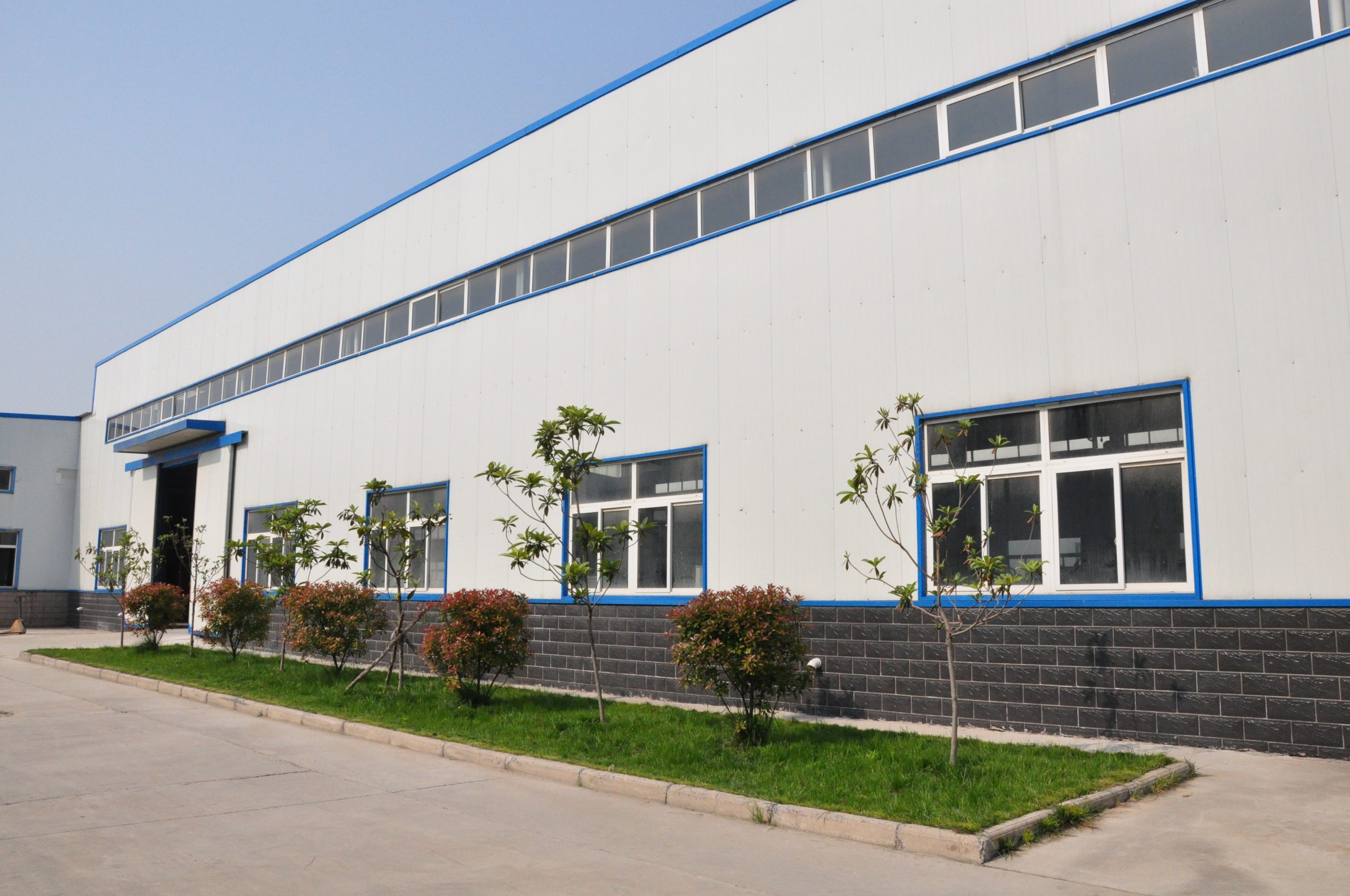
Kaifeng Xinya Instrument Co., Ltd. is a professional industrial flow measurement manufacturer specializing in electromagnetic flow meters and IoT-integrated monitoring solutions for industrial, municipal, and food safety applications. As a source factory, the company maintains manufacturing experience supported by NewAsia Industrial since 1996, combined with independent R&D capability in excitation drive systems and signal processing technology.
The company’s product range includes standard electromagnetic flow meters, hygienic electromagnetic flow meters, battery-powered/wireless remote flow meters, ceramic-lined and abrasion-resistant slurry flow meters, and insertion-type flow meters for large-diameter pipelines. Products comply with JB/T9248-2015 and GB/T9124.1-2019 standards, with sensor protection ratings up to IP68 for submerged or buried installations.
Kaifeng Xinya supports factory calibration capability, OEM/ODM customization, and global export experience, offering hardware combined with an IoT Big Data Platform for centralized monitoring and remote data access. This positions the company to address both standard process flow measurement needs and specialized applications such as abrasive slurry or hygienic fluid handling relevant to paper and adjacent process industries.
10. Frequently Asked Questions (FAQ)
Q1: Can electromagnetic flow meters measure pulp slurry with high fiber content?
Yes, provided the slurry maintains sufficient electrical conductivity. Abrasion-resistant lining such as polyurethane or PFA is recommended to withstand fiber and particulate contact.
Q2: What liner material is best suited for paper industry chemical lines?
PTFE or PFA liners are generally suitable for corrosive bleaching chemicals, while polyurethane or rubber liners are preferred for abrasive pulp stock lines.
Q3: How accurate is electromagnetic flow measurement in paper mill applications?
Standard accuracy is typically ±0.5%, with optional ±0.2% or ±0.3% grades available for applications requiring tighter chemical dosing control.
Q4: What causes signal instability in slurry flow measurement?
Solid particle or fiber collision with electrodes can generate spike-like interference. Converters equipped with variation restraint algorithms help filter this disturbance.
Q5: Does the flow meter require periodic calibration?
Yes. Periodic verification against a traceable reference, such as a master meter method, helps confirm continued measurement accuracy over the equipment’s service life.
Q6: What electrode material should be used for bleaching chemical streams?
Hastelloy, titanium, or tantalum electrodes are commonly selected for corrosive chemical exposure, depending on the specific chemical composition.
Q7: Can this type of flow meter be installed in remote areas without power infrastructure?
Battery-powered electromagnetic flow meters with wireless data transmission are available for installations lacking grid power access.
Q8: How should pipe size be selected for large paper mill process lines?
Pipe size should match the existing process line diameter, with electromagnetic flow meters available across a wide DN range to accommodate both instrumentation branches and large headers.
11. Conclusion
Paper industry flow measurement requires instrumentation capable of handling conductive, fibrous, and sometimes corrosive process fluids while maintaining consistent accuracy over long operating periods. Electromagnetic flow meters, supported by appropriate lining and electrode material selection, address these requirements effectively across pulping, bleaching, and papermaking stages.
Proper selection depends on careful evaluation of medium characteristics, conductivity, pipe size, and installation conditions, along with attention to calibration and maintenance practices for long-term reliability.
Engineers and procurement teams evaluating flow measurement solutions for paper industry applications are welcome to consult with Kaifeng Xinya Instrument Co., Ltd. for technical guidance on model selection, material compatibility, and application-specific configuration.
Reviews
There are no reviews yet.