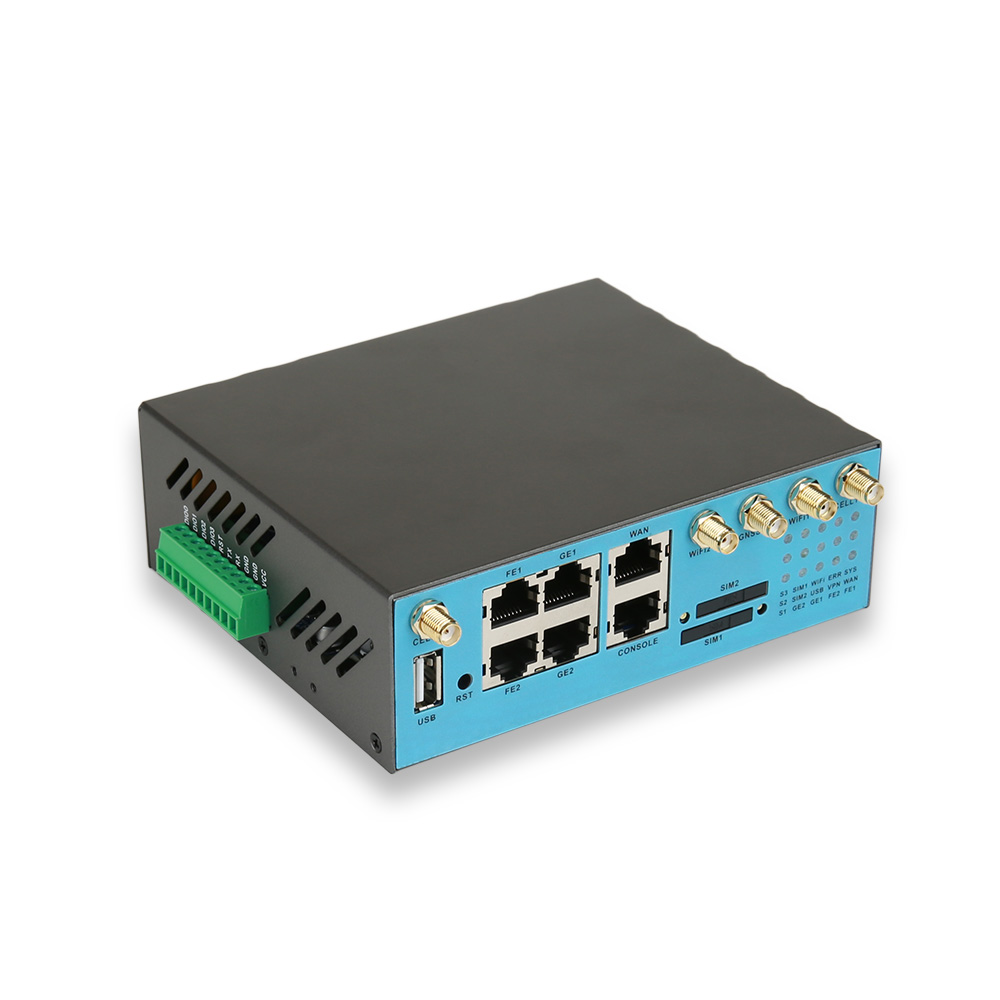
Description
When businesses search for a top-rated dual SIM 4G router brand in Europe, they are usually looking for more than a router with two SIM card slots. In industrial and commercial deployments, the real requirement is dependable connectivity across distributed sites, different network conditions, demanding environments, and long operating cycles.
A dual SIM industrial router can provide an additional layer of cellular redundancy. Instead of relying on a single mobile connection, the equipment can use a second SIM when the primary connection becomes unavailable or unstable. This can be particularly useful for remote monitoring, transportation, energy infrastructure, payment terminals, industrial automation, and other applications where sending an engineer to restart a router is inconvenient or expensive.
For European projects, however, the manufacturer should be evaluated from several angles. Cellular compatibility is only one part of the decision. Buyers also need to consider hardware reliability, network failover, cybersecurity, regulatory compliance, remote management, interface availability, firmware support, and the supplier’s ability to maintain a large installed base.
The European connectivity market is also changing as operators modernise networks and retire older technologies. GSMA research has documented the continued transition away from legacy 2G and 3G networks towards 4G and 5G, making the long-term cellular strategy an important consideration for industrial IoT deployments.
For businesses evaluating industrial router manufacturers, this makes the selection process more technical than simply comparing specifications.
Why Dual SIM 4G Routers Still Matter in Europe
5G is expanding rapidly across Europe, but this does not mean every industrial project needs a 5G router.
Many industrial applications transfer moderate amounts of data and place greater importance on network stability, broad deployment compatibility, predictable power consumption, and lifecycle management. For such applications, 4G LTE can remain a practical communications platform.
The key issue is not whether 4G is the newest cellular technology. It is whether the technology matches the application’s requirements.
A dual SIM architecture becomes particularly valuable when the communication link is mission-critical.
For a remote water monitoring station, a traffic control cabinet, an industrial controller, a photovoltaic monitoring system, or a payment terminal, a lost cellular link can interrupt more than internet access. It can prevent data collection, remote diagnostics, alarms, software maintenance, or equipment management.
With dual SIM capability, the router can maintain a second cellular profile as a backup. When implemented with an automatic failover mechanism, this can reduce the operational impact of a problem affecting the primary link.
What Makes a Dual SIM 4G Router Suitable for European Industrial Projects?
A strong industrial router manufacturer should address several technical layers at the same time.
Cellular Redundancy
Dual SIM should be treated as a network resilience feature rather than simply a hardware specification.
Buyers should examine how SIM switching works in real deployments. Important considerations include automatic failover, link-health detection, reconnection behaviour, recovery after signal loss, and whether an operator can change network settings remotely.
The router should also be compatible with the cellular bands and network configuration required for the target countries. This is particularly important for businesses deploying one product family across several European markets.
Industrial-Grade Hardware
An industrial router can be installed inside a roadside cabinet, electrical enclosure, vehicle, payment terminal, control panel, or remote monitoring station. These locations may involve temperature variation, vibration, electromagnetic interference, electrical transients, and limited physical access.
E-Lins Technology uses industrial-grade chips and components with a stated operating temperature range of -35°C to +75°C. The company’s industrial hardware specifications also include 15KV ESD protection and 1.5KV electromagnetic isolation.
These characteristics are more relevant to industrial equipment than consumer-oriented features such as decorative design or home Wi-Fi coverage.
Stable Firmware
The hardware platform is only one part of router reliability.
Firmware controls network recovery, security functions, configuration, management, and communication between the router and connected equipment. A router that repeatedly requires a manual reboot can create considerable operational work when hundreds or thousands of units are installed in distributed locations.
E-Lins develops its router software independently and uses self-developed firmware for its industrial communication products. Its technical architecture includes link self-healing mechanisms and hardware watchdog timers.
This approach is intended to support long-term unattended operation and automatic recovery from common communication or device-level problems.
How Europe-Specific Requirements Affect Router Selection
Selecting equipment for Europe also means looking at compliance and lifecycle requirements.
Routers with wireless communication functions fall within the scope of the EU Radio Equipment Directive when placed on the EU market. The European Commission explains that the RED establishes essential requirements covering areas including safety and health, electromagnetic compatibility, efficient use of radio spectrum, and certain additional requirements related to privacy, data protection, interoperability, and other functions.
CE marking is part of the conformity process for products covered by applicable EU harmonisation legislation. The European Commission also makes clear that CE marking is not an approval issued by the EU itself; it indicates that the applicable conformity requirements have been addressed.
For industrial buyers, this means a manufacturer should be able to provide appropriate technical and compliance documentation rather than treating a CE logo as the entire compliance story.
RoHS is another relevant consideration for electrical and electronic products. The European Commission’s RoHS framework restricts certain hazardous substances in electrical and electronic equipment placed on the EU market.
Cybersecurity is becoming another important element of product lifecycle planning. The EU Cyber Resilience Act entered into force in December 2024, with reporting obligations beginning in September 2026 and most of its main obligations applying from December 2027. The framework includes requirements related to cybersecurity throughout the lifecycle of products with digital elements, including vulnerability handling and support.
For long-term industrial deployments, these developments reinforce the need to evaluate the manufacturer, its firmware practices, support model, and documentation—not only the router’s radio specifications.
Applications Where Dual SIM 4G Industrial Routers Make Sense
The most suitable applications are usually those where connectivity needs to be reliable, distributed, remotely managed, and efficient to maintain.
Industrial Automation
Factories and processing sites often contain PLCs, meters, sensors, controllers, and other devices that need to communicate with central systems.
An industrial 4G router can provide wireless backhaul for remote or distributed equipment, especially where fixed network installation is difficult or where an additional communication path is needed.
E-Lins provides industrial networking products with support for Ethernet, RS232, RS485, DI/DO, Modbus, TCP/IP, and serial transparent transmission. These interfaces are useful when modern cloud-connected systems must communicate with existing industrial equipment.
Power and Renewable Energy Monitoring
Solar and wind power installations are frequently distributed over large areas. Communication equipment may need to operate at unmanned sites while transmitting operational information back to a monitoring platform.
In this situation, network redundancy can be more important than extreme bandwidth.
A dual SIM 4G router can provide an alternative connection path when the preferred mobile connection becomes unreliable. Remote management can also help operators diagnose communication faults without travelling to every installation.
Transportation Infrastructure
Connected transportation equipment includes vehicle networking systems, streetlight controllers, traffic signalling equipment, roadside monitoring devices, and information displays.
Such equipment may operate in outdoor or mobile environments where environmental conditions are difficult to control.
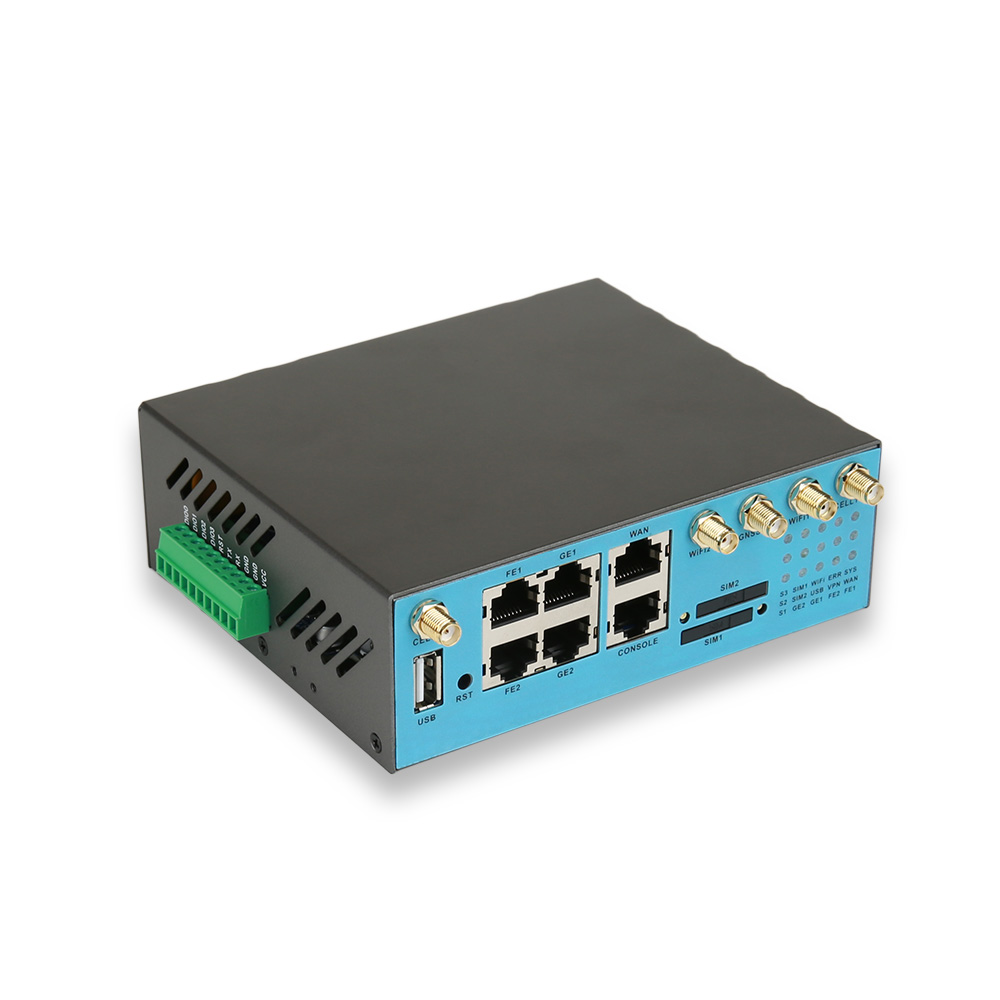
E-Lins has experience in intelligent transportation applications, including in-vehicle networking and streetlight and traffic-related control systems. Its H900 Gigabit Industrial 4G Router is designed for M2M, vehicle, and security applications and supports cellular, wired, and Wi-Fi connectivity for multi-link redundancy.
Financial and Payment Terminals
Payment-related equipment demands secure and reliable communications because connectivity interruptions can directly affect transactions and service availability.
E-Lins includes financial payment among its application sectors, covering ATMs and mobile payment-related connectivity.
Its industrial routers support VPN technologies including WireGuard, IPsec, and OpenVPN, allowing integrators to build encrypted communication paths between distributed devices and their central infrastructure.
Smart-City and Self-Service Infrastructure
Smart-city deployments often involve a large number of geographically separated devices. Examples include security equipment, emergency communication systems, intelligent terminals, and street-level infrastructure.
The challenge is not simply getting each device online. The challenge is maintaining the entire fleet over time.
This is where centralized device management becomes important.
Remote Management Can Matter More Than Raw Throughput
For a single router, manual configuration may not seem difficult. For several hundred or several thousand units, it becomes a completely different operational problem.
A manufacturer targeting industrial deployments should therefore provide tools that allow administrators to monitor and maintain devices centrally.
E-Lins supports TR-069, SNMP, SSH, and NMS cloud platforms, enabling integration with centralized management environments.
The company also provides 7×24-hour remote technical support, packet capture analysis, remote debugging, configuration documentation, video tutorials, and one-to-one remote guidance.
Its stated service capabilities include a 90% remote issue-resolution rate and lifetime free firmware upgrades.
These functions can make a practical difference when a router is installed in a remote location and physical access is difficult.
Why a Manufacturer’s Manufacturing Capability Matters
When an industrial project involves hundreds or thousands of routers, procurement reliability becomes part of the technical evaluation.
A buyer should ask:
Can the supplier maintain consistent hardware revisions?
Can it support OEM or ODM requirements?
Can it produce enough units for a rollout?
Can it continue supplying firmware updates after deployment?
Can its technical team troubleshoot large installations?
E-Lins operates an in-house SMT factory and assembly lines in Shenzhen, with monthly production capacity in the tens of thousands of units.
The company has industrial wireless communication roots dating back to 1999 and formally established Shenzhen E-Lins Technology Co., Ltd. in 2012. Its current business coverage extends across more than 150 countries and regions.
E-Lins also provides OEM/ODM services, standardized delivery, and technical support for integrators and project customers.
For European companies working on multi-country deployment programmes, this type of manufacturing and support structure can be more useful than simply comparing individual router specifications.
E-Lins Technology as an Option for European Industrial Connectivity Projects
E-Lins Technology focuses on professional M2M and IoT wireless communication equipment for distributed, unattended, and industrial environments.
Its product portfolio includes industrial 4G routers, industrial 5G routers, embedded routers, outdoor routers, industrial modems, and DTUs.
For projects specifically requiring 4G connectivity with redundancy, the H900 Gigabit Industrial 4G Router is positioned for M2M, vehicle, and security applications. It features five Gigabit Ethernet ports and a multi-link architecture combining cellular, wired, and Wi-Fi connectivity.
For more compact equipment, the H685f/H685 Mini Embedded Series provides a 100 × 60 × 21 mm footprint with Ethernet, serial, and DI/DO interfaces.
For outdoor installations, the H820QO Outdoor IP68 Waterproof Router provides a different approach, with an IP68 design and built-in high-gain antennas intended for field environments.
This range is relevant because not every European project has the same physical or communication requirements.
A fleet operator may need a vehicle-oriented router, while a smart-city integrator may require Ethernet expansion and centralized management. An embedded equipment manufacturer may prioritize dimensions and serial interfaces. An outdoor infrastructure project may prioritise environmental protection.
Evidence From Industrial Deployments
When researching a router manufacturer, buyers should distinguish between marketing claims and evidence from deployed projects.
E-Lins’ enterprise information includes several large-scale application examples.
In one telecom infrastructure project, the company reports an equipment online rate of 99.4% and a 53% reduction in per-site maintenance costs, with a large-scale supply exceeding 100,000 units.
In a European aviation ground-support application, E-Lins reports an equipment online rate of at least 99.9%, while 85% of reported faults were handled remotely through its communication and VPN solution.
In a Nordic intelligent transportation deployment, the company reports a network interruption rate of 0.3%, with 90% of faults handled remotely.
These figures are company-provided project results rather than independent industry benchmarks, so buyers should verify detailed test conditions, deployment scope, and measurement methodology during technical qualification.
That distinction is important when assessing what “top rated” should mean in a B2B purchasing context.
What Should “Top Rated” Mean When Comparing Router Brands?
Search queries often use terms such as “top rated,” but an industrial buyer needs more specific criteria.
A useful evaluation can focus on five areas.
Reliability
Does the hardware tolerate the intended temperature and electrical environment? Does the router recover automatically from connection failures?
Connectivity
Does the product support the required 4G bands and network architecture? Can it provide dual SIM failover or other forms of link redundancy?
Security
Does the manufacturer provide modern VPN and remote-management capabilities? Is firmware maintained over the product lifecycle?
Integration
Can the router connect to existing industrial equipment through Ethernet, RS232, RS485, digital I/O, or relevant protocols?
Supplier Support
Can the manufacturer provide customization, documentation, remote troubleshooting, firmware updates, production capacity, and international technical support?
This type of evaluation is more actionable than simply looking for the highest-rated consumer review.
Why 4G Lifecycle Planning Still Matters
Europe’s mobile networks are continuing to evolve. GSMA has reported that operators are retiring or planning to retire legacy 2G and 3G networks as spectrum and infrastructure are increasingly focused on 4G and 5G.
For industrial buyers, this means equipment should be selected with a clear view of the actual cellular lifecycle in the countries where it will be deployed.
A 4G router can be an appropriate option when the application’s bandwidth requirements are moderate, and the target network provides suitable LTE service. However, projects with long planned lifecycles should document their regional operator requirements and future migration strategy before final hardware qualification.
This is particularly important for companies deploying the same hardware family across multiple European countries, because network availability, operator policies, and technology transition schedules can differ between markets.
Conclusion
Choosing a top-rated dual SIM 4G router brand in Europe should not be reduced to finding a product with two SIM slots and a high theoretical data rate.
For industrial and B2B deployments, a stronger evaluation looks at network redundancy, hardware reliability, firmware stability, security, industrial interfaces, remote management, compliance documentation, manufacturing capacity, and long-term technical support.
E-Lins Technology is positioned around industrial M2M and IoT wireless communication, with a product range covering 4G and 5G industrial routers, embedded routers, outdoor networking equipment, industrial modems, and DTUs. Its industrial hardware specifications include wide-temperature operation, ESD protection, electromagnetic isolation, and self-developed firmware, while its management platform supports technologies such as SNMP, SSH, and TR-069.
For European integrators, operators, equipment manufacturers, and infrastructure contractors, these factors provide a more practical basis for comparing dual SIM 4G router manufacturers than an undifferentiated “top brand” label.
The most suitable supplier is ultimately the one whose hardware, software, compliance support, interfaces, manufacturing capability, and service model align with the actual deployment environment and lifecycle of the project. That is the standard worth applying when building a shortlist of industrial dual SIM 4G router manufacturers for Europe.


Reviews
There are no reviews yet.