
Description
Published: November 2026 | By DK Engineering Team
Thicker steel sounds like the safer choice, yet acoustic contractors keep specifying the thinner one. That is the core of why 25 gauge hat channel for soundproofing instead of 20 gauge has become the default answer for decoupled ceiling and wall assemblies. A 25-gauge channel is roughly 0.45–0.5 mm of galvanized steel; a 20-gauge channel runs 0.88–1.0 mm — nearly double the thickness and the weight. In a floor-ceiling assembly hung on isolation clips, that extra stiffness does not add sound insulation. It removes the one property the system depends on: controlled flex across the span. Below we break down the physics, the load limits, and the rare jobs where 20 gauge still wins. The comparison assumes the profile that matters in 90% of sound assemblies: a 7/8-inch galvanized hat channel hung on isolation clips, the configuration this factory rolls daily.
1. Does hat channel gauge affect sound transmission and decoupling?
Yes — gauge directly affects decoupling performance, and the effect runs opposite to intuition: thinner 25-gauge channel outperforms stiff 20-gauge channel in clip-supported assemblies. Anyone asking does hat channel gauge affect sound transmission decoupling needs one concept first: a decoupled ceiling works by letting the drywall layer move independently of the structure. The channel is the spring in that system, not the shield.
• Mass contributes little: moving from 25 to 20 gauge adds about 0.35 kg per square meter — roughly one extra half-percent of assembly mass. By the mass law, that is worth well under 1 STC point.
• Stiffness costs points: a stiff 20-gauge flange bridges between isolation clips and transmits vibration straight through, behaving closer to a rigid connector. Measured assemblies show 2–5 STC points lost when a rigid channel replaces a properly flexible one.
• Flex is the feature: 25-gauge steel deflects microscopically between clips spaced up to 48" apart, absorbing energy in the steel itself the way the neoprene in the clip absorbs it in rubber.
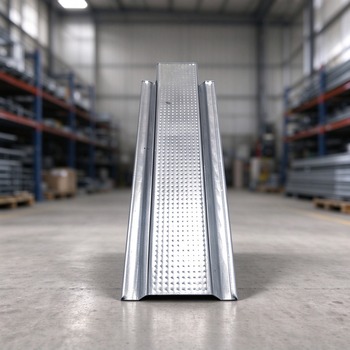
• Hemmed edges matter: the folded long edges on a sound-rated 25-gauge profile stabilize the thin flange so it flexes predictably instead of rattling — a construction detail we roll into every DK 7/8" drywall furring channel.
The same logic explains why installers who upgrade to heavier channel "to be safe" sometimes report ceilings that test worse than before. They did not buy more performance; they bought a shortcut for vibration.
✅ Bottom line: In clip systems, the channel must flex to work. 25 gauge flexes; 20 gauge bridges. Gauge choice is an acoustic decision, not just a structural one.
2. What are the hemmed edge and load-capacity trade-offs?
Hemmed long edges give a 25-gauge channel safe handling, stable flange behavior and the controlled flexibility that plain-cut thin steel lacks — those are the practical hemmed edge hat channel acoustic flexibility benefits. The fold doubles the local stiffness at the flange tip, so the profile can stay thin in the web yet resist the sharp local deflection that causes oil-canning and screw pull-through. It also removes the razor edge that bare 25-gauge steel leaves on installers' hands — in other words, the hemmed edge hat channel acoustic flexibility benefits are engineered into the profile at the mill, not improvised on site.
• Load limits to respect: a 25-gauge 7/8" channel on clips at 24" on center carries single or double 5/8" drywall comfortably; beyond that, tighten clip rows to 16" on center or move to a 20-gauge profile. That load-versus-stiffness trade is exactly why 25 gauge hat channel for soundproofing instead of 20 gauge remains the acoustic default even on heavy ceilings — you tighten the spacing instead of stiffening the spring.
• When 20 gauge wins: direct-fastened leveling frames (no clips), heavy tile-backer ceilings, and spans over 48" without intermediate support. In those roles stiffness helps and decoupling is not the goal.
• Cost and freight: 25 gauge uses about half the steel per foot. On a container of 20,000 linear feet, that difference alone shifts the landed cost noticeably — one reason distributors order thin-gauge channel in bulk from the factory.
• Zinc coating stays the same: both gauges take the same 30–150 g/m² galvanized layer range, so corrosion life is a coating decision, not a gauge decision.
So the honest answer to does hat channel gauge affect sound transmission decoupling is: massively, through stiffness — while mass barely moves the needle at all.
✅ Bottom line: Choose 25 gauge with hemmed edges for any clip-supported soundproofing assembly; reserve 20 gauge for rigid, direct-fastened framing where leveling — not decoupling — is the job.
FAQ
Q: Why 25 gauge hat channel for soundproofing instead of 20 gauge when 20 gauge is stronger?
A: Stronger is the problem. A clip-supported ceiling needs the channel to deflect between clips so vibration is absorbed rather than bridged. The strength you want lives in the joists and the drywall, not in the spring.
Q: Can I mix gauges in one ceiling — 20 gauge in the field and 25 gauge elsewhere?
A: Technically yes, but the mixed assembly tests to the weakest link and crews install inconsistently. Specifying one 25-gauge hemmed profile throughout keeps the STC rating defensible and simplifies ordering.
Q: What should I check before ordering 25-gauge channel from a factory?
A: Three things: actual thickness tolerance (ask for measured readings, not just "25 gauge"), hemmed long edges as standard, and zinc coating grams. DK rolls 25-gauge furring channel at 0.45–0.5 mm with hemmed edges and supplies mill certificates with every shipment.
Order Gauge-Specified Furring Channel Direct
Nanjing Jinkongjian Building Materials Co., Ltd. manufactures DK galvanized hat and omega channels in 0.3–0.6 mm with hemmed edges as standard, backed by 22 years of OEM/ODM experience and fully automated roll-forming lines. Send us your assembly detail and clip spacing — our engineers will confirm the correct gauge, return a loading plan and quote factory-direct within 48 hours. See the DK omega furring channel or suspended ceiling profile range to start.
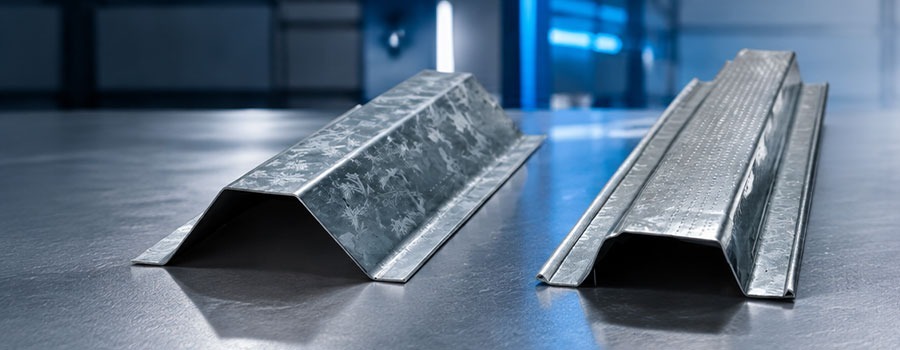
Galvanized furring channel profiles: thin-gauge with hemmed edges is the acoustic specification; heavier gauges belong in rigid leveling frames.


Reviews
There are no reviews yet.