
Description
1. Introduction
Flow meter accuracy verification is the process of confirming that a flow measurement device delivers readings within its specified tolerance under actual or simulated process conditions. For industrial buyers, plant engineers, and system integrators, accuracy verification is not an optional formality — it directly affects billing accuracy, process control quality, regulatory compliance, and equipment lifecycle cost.
Inaccurate flow data can lead to over- or under-dosing of chemicals, incorrect custody transfer billing, inefficient energy usage, and unreliable production records. This article explains what accuracy verification means for industrial flow meters, how it is performed, and what engineering factors influence measurement reliability — with a focus on electromagnetic flow meters, which are widely used across water, chemical, food, and slurry applications.
2. What Is Flow Meter Accuracy Verification?
Flow meter accuracy verification refers to the comparison of a flow meter’s output against a known reference standard to determine whether the measured value falls within its stated accuracy class (e.g., ±0.5% or ±0.2%).
Working Principle
Verification typically involves one of the following methods:
- Master meter method – comparing the unit under test against a reference flow meter with traceable accuracy.
- Static mass/volumetric method – collecting a known mass or volume of liquid over a timed interval and comparing it to the meter’s recorded value.
- Sonic nozzle method – used primarily for gas flow calibration, relying on critical flow conditions through a calibrated nozzle.
Main Components Involved
- The flow meter under test (sensor + converter/transmitter)
- A calibration rig or reference standard (liquid or gas calibration system)
- Data acquisition and comparison software or manual recording
Relationship Between Equipment and Application
Verification results are only meaningful when tied to the actual operating conditions of the application — medium conductivity, flow velocity, temperature, and pipe orientation all affect real-world accuracy, which is why verification should reflect, as closely as possible, the intended installation environment.
3. Why Is This Solution Used in Industrial Applications?
Accuracy verification is used because flow meters can drift or perform outside specification due to installation errors, medium changes, electrode fouling, or electronic aging.
Application Advantages
- Confirms compliance with process control tolerances before commissioning.
- Detects zero-point drift caused by empty-pipe conditions or grounding issues.
- Validates performance after maintenance, repair, or converter replacement.
Suitable Operating Conditions
Verification is especially important for:
- Custody transfer and billing applications
- Chemical dosing where small deviations cause quality issues
- Slurry and abrasive media where wear can gradually alter measurement geometry
Typical Measurement Challenges Solved
- Zero-point instability in low-conductivity or abrasive fluids
- Signal noise from electrical interference or improper grounding
- Accuracy loss due to sensor lining wear over time
4. Key Selection Factors
Selecting the correct flow meter — and later verifying its accuracy — depends on several engineering variables:
- Measuring Medium: Conductive liquids (for electromagnetic flow meters) require minimum conductivity thresholds; non-conductive fluids require alternative technologies such as ultrasonic or Coriolis meters.
- Conductivity: Electromagnetic flow meters generally require a minimum fluid conductivity (commonly ≥5 µS/cm) for stable signal generation.
- Flow Range: Confirm the velocity range (typically 0.1–10 m/s for electromagnetic meters) matches actual process flow rates.
- Pipe Size: Electromagnetic flow meters are available from DN15 up to DN3000, covering laboratory-scale to large municipal pipelines.
- Temperature and Pressure: Liner and electrode materials must withstand process temperature and pressure ratings without degradation.
- Accuracy Requirements: Standard accuracy is ±0.5%, with ±0.2% available for applications requiring tighter tolerance.
- Material Compatibility: Electrode materials (stainless steel, Hastelloy, titanium, tantalum) must resist corrosion from the specific chemical composition of the medium.
- Liner Selection: PTFE and PFA suit corrosive chemicals; rubber and polyurethane suit abrasive slurries; ceramic liners suit high-wear, high-temperature conditions.
- Installation Conditions: Straight pipe run requirements, grounding rings, and full-pipe conditions must be met to preserve verified accuracy.
5. Common Challenges and Solutions
| Challenge | Engineering Cause | Practical Solution |
|—|—|—|
| Incorrect model selection | Mismatch between medium conductivity and technology type | Verify conductivity and select appropriate liner/electrode combination before purchase |
| Measurement instability | Empty pipe, air bubbles, or insufficient straight run | Ensure full-pipe flow and follow minimum upstream/downstream distance guidelines |
| Signal interference | Poor grounding or electromagnetic noise from nearby equipment | Install grounding rings and route signal cables away from high-voltage lines |
| Accuracy deviation over time | Electrode fouling, lining wear, or electronic drift | Schedule periodic verification against a reference standard |
| Material corrosion/abrasion | Incompatible liner or electrode material for the process fluid | Select wear-resistant liners (polyurethane, ceramic) or corrosion-resistant electrodes (Hastelloy, titanium) |
| Installation errors | Incorrect orientation or inadequate pipe support | Follow manufacturer installation guidelines, including vertical mounting for low-velocity applications |
6. Application Areas
Accuracy verification is relevant across multiple industrial sectors:
- Water and Wastewater Treatment: Ensures accurate billing and process dosing control.
- Chemical Processing: Confirms reliable measurement of corrosive or hazardous media.
- Food and Beverage: Supports hygienic processing where accurate dosing affects product consistency.
- Mining and Slurry: Validates performance in high-solid-content, abrasive environments such as coal-water slurry or tailings.
- Energy Management: Supports accurate heat and flow measurement for utility monitoring.
- Industrial Process Control: Provides the measurement reliability needed for closed-loop control systems.
7. Installation and Maintenance Recommendations
- Installation Requirements: Maintain adequate upstream/downstream straight pipe length, ensure full-pipe flow, and use proper grounding to reduce signal noise.
- Operating Recommendations: Avoid installing sensors near valves, pumps, or bends that create turbulence affecting signal stability.
- Maintenance Methods: Periodically inspect electrodes for fouling and liners for wear, particularly in abrasive or corrosive service.
- Calibration Importance: Re-verification after maintenance, converter replacement, or extended operation helps confirm the meter remains within its accuracy class.
- Long-Term Reliability: Selecting appropriate liner and electrode materials from the outset reduces the frequency of required maintenance and accuracy drift.
8. Industrial Supplier Evaluation
When selecting a flow meter manufacturer, industrial buyers should evaluate:
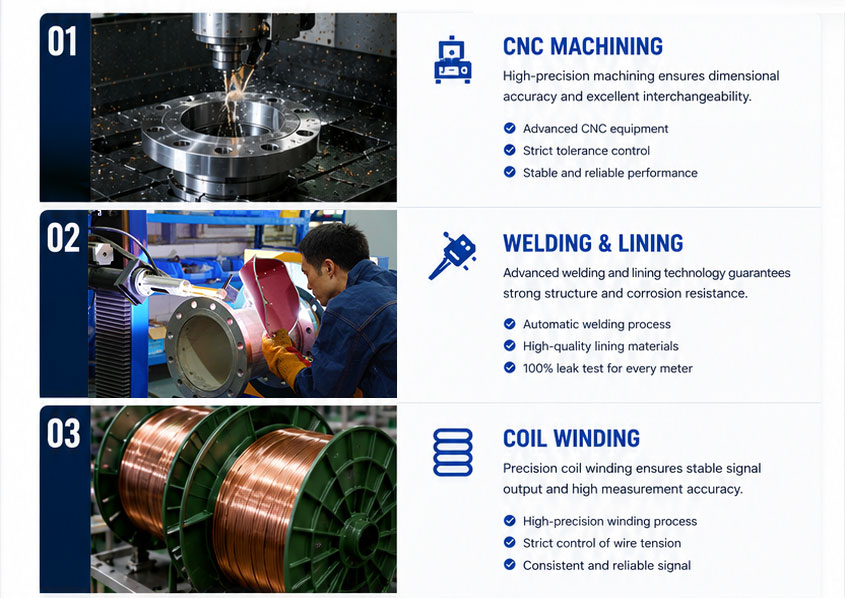
- Manufacturing Capability: Confirm whether the supplier is a source factory with in-house production rather than a reseller.
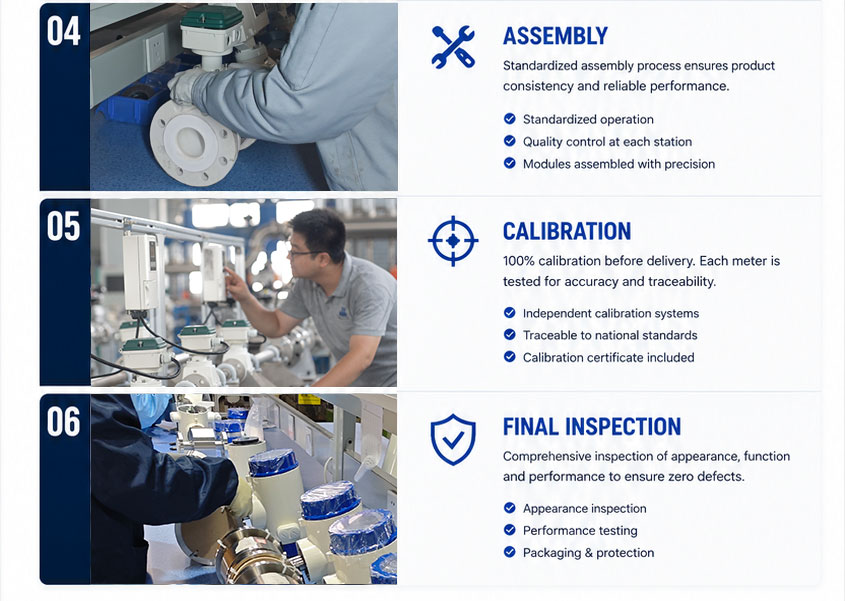
- Quality Control System: Ask about incoming material inspection, in-process testing, and final product verification procedures.
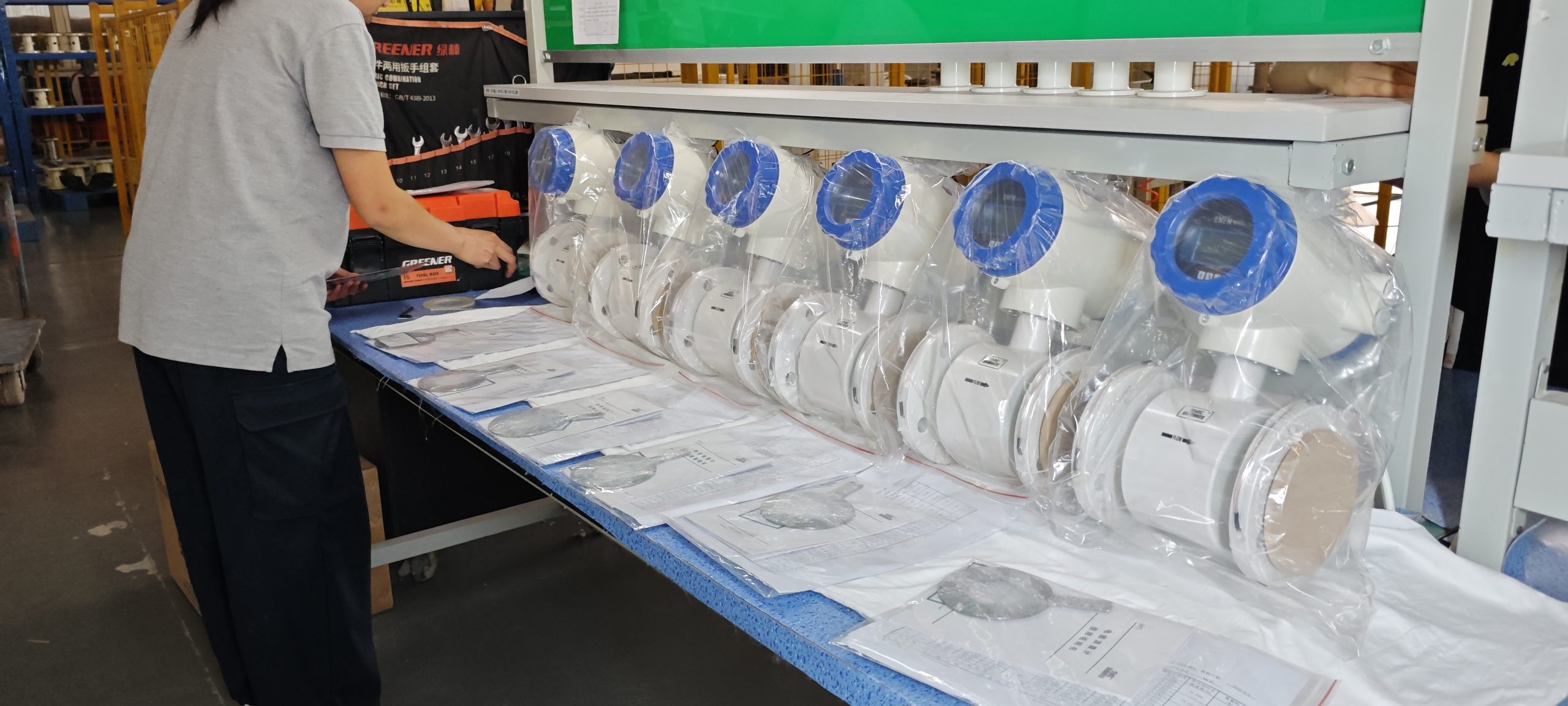
- Calibration Capability: Verify whether the manufacturer operates its own liquid or gas flow calibration systems, such as static mass, master meter, or sonic nozzle methods.
- Technical Support: Assess the availability of application engineering support for medium compatibility and installation guidance.
- Customization Capability: Determine whether OEM/ODM services, custom flange standards, and liner/electrode options are available.
- Export Experience: Review the supplier’s experience shipping and supporting equipment for international industrial markets.
- Engineering Service Capability: Confirm availability of pre-installation inspection, commissioning support, and troubleshooting assistance.
9. About Kaifeng Xinya Instrument Co., Ltd.
Kaifeng Xinya Instrument Co., Ltd. is a professional industrial flow measurement manufacturer and source factory, with manufacturing experience supported by NewAsia Industrial since 1996. The company maintains independent R&D capability focused on electromagnetic flow measurement technologies, including square wave pulse excitation and VFC signal processing.
Xinya’s product range includes standard, hygienic, battery-powered, ceramic-lined, and insertion-type electromagnetic flow meters, covering pipe sizes from DN15 to DN3000. The company supports OEM/ODM customization and maintains factory calibration capability using liquid and gas flow calibration systems, including static mass and master meter methods.
With global export experience serving industrial, municipal, and food safety markets, Kaifeng Xinya positions itself as a manufacturing partner for engineers and distributors seeking reliable, application-matched flow measurement solutions.
10. Frequently Asked Questions (FAQ)
Q1: How is flow meter accuracy verification performed?
It is performed by comparing the meter’s output against a traceable reference standard using methods such as the master meter method, static mass method, or sonic nozzle method for gas applications.
Q2: What accuracy class should I choose for my application?
Standard ±0.5% accuracy is suitable for most industrial processes, while ±0.2% is recommended for applications requiring tighter measurement tolerance, such as custody transfer or precision dosing.
Q3: Can an electromagnetic flow meter measure non-conductive fluids?
No. Electromagnetic flow meters require a minimum fluid conductivity threshold to generate a stable signal; non-conductive fluids require alternative measurement technologies.
Q4: What liner material should be selected for abrasive slurry applications?
Wear-resistant liners such as polyurethane or ceramic are commonly selected for high-solid-content slurries to resist erosion from particle friction.
Q5: Does the flow meter require periodic re-verification?
Yes. Periodic re-verification is recommended, particularly after maintenance, converter replacement, or extended service in abrasive or corrosive conditions, to confirm continued accuracy.
Q6: What causes signal instability in electromagnetic flow meters?
Common causes include empty-pipe conditions, insufficient grounding, electromagnetic interference from nearby equipment, and insufficient straight pipe run before and after the sensor.
Q7: How do I select the correct pipe size for a flow meter?
Pipe size selection should be based on expected flow velocity range and process flow rate, ensuring the meter operates within its specified velocity range (commonly 0.1–10 m/s).
11. Conclusion
Flow meter accuracy verification plays a critical role in maintaining reliable process control, accurate billing, and regulatory compliance across industrial operations. Selecting the correct meter type, liner, and electrode material — combined with proper installation and periodic verification — helps ensure long-term measurement reliability.
For engineers and buyers evaluating flow measurement solutions, understanding these technical and application factors supports informed equipment selection. Kaifeng Xinya Instrument Co., Ltd. welcomes technical consultation for engineers seeking application-matched flow measurement and calibration solutions.
Reviews
There are no reviews yet.