Description
Understanding the Power Interruption Challenge for ONT Devices
Optical Network Terminals (ONTs) serve as the critical link between fiber network infrastructure and in-home connectivity, translating optical signals into usable data for routers, gateways, and other networked equipment. Because ONTs sit at this essential junction, even a short power outage, a voltage drop, or unstable grid conditions can cause a full reboot, resulting in lost sessions, dropped connections, or interrupted monitoring feeds for security equipment. For telecom operators, Internet Service Providers (ISPs), broadband network companies, fiber network operators, and system integrators, this type of service disruption directly affects customer experience and operational reliability.
Selecting an appropriate Mini UPS backup power solution for ONT devices is therefore not simply a matter of choosing any battery backup unit. Improper selection regarding voltage, current, peak load, or connectors can lead to application failure, meaning the backup unit may not actually protect the device it is meant to support. This is the central pain point that shapes how a Mini UPS should be evaluated before deployment.
Key Factors in Choosing a Mini UPS for ONT Backup
Matching Voltage and Working Current
The starting point for any Mini UPS selection is confirming the real device voltage and working current of the ONT in question. A UPS that does not match these baseline electrical requirements will not deliver dependable backup, regardless of its rated capacity. Evaluation based on actual device specifications, rather than assumptions, helps ensure the backup unit operates within the ONT’s expected input parameters.
Accounting for Peak and Startup Behavior
Beyond steady-state current, many networking devices draw higher peak or startup current when powering on or re-establishing a connection. A sound Mini UPS selection process accounts for this peak/startup behavior so the backup power source can support the device through its full operating cycle, not only during normal continuous operation.
Connector and Cable Compatibility
Even when voltage and current are correctly matched, a mismatched connector or cable can prevent a Mini UPS from functioning with a given ONT. Technical confirmation of connector and cable compatibility is a necessary step in the selection process, helping reduce avoidable installation errors in professional deployments.
Battery Capacity and Runtime Requirements
Battery energy capacity, measured in Wh, determines how long a Mini UPS can sustain a connected ONT during an outage. Depending on whether the application involves short residential outages or longer-duration interruptions in remote areas, project teams should weigh battery capacity against expected outage duration and the device’s power draw.
Installation Environment
Finally, the installation environment, including available power input (AC or DC), physical space constraints, and whether multiple devices such as an ONT and a router need to be powered simultaneously, should inform the final product selection.
A Product Portfolio Built Around These Selection Criteria
Shanghai Mylion New Energy Co., Ltd., operating under the MYLION brand, has organized its Mini UPS product lineup to address exactly these variables, drawing on more than 13 years of experience in lithium battery technology and more than 10 years of experience in Mini UPS development.
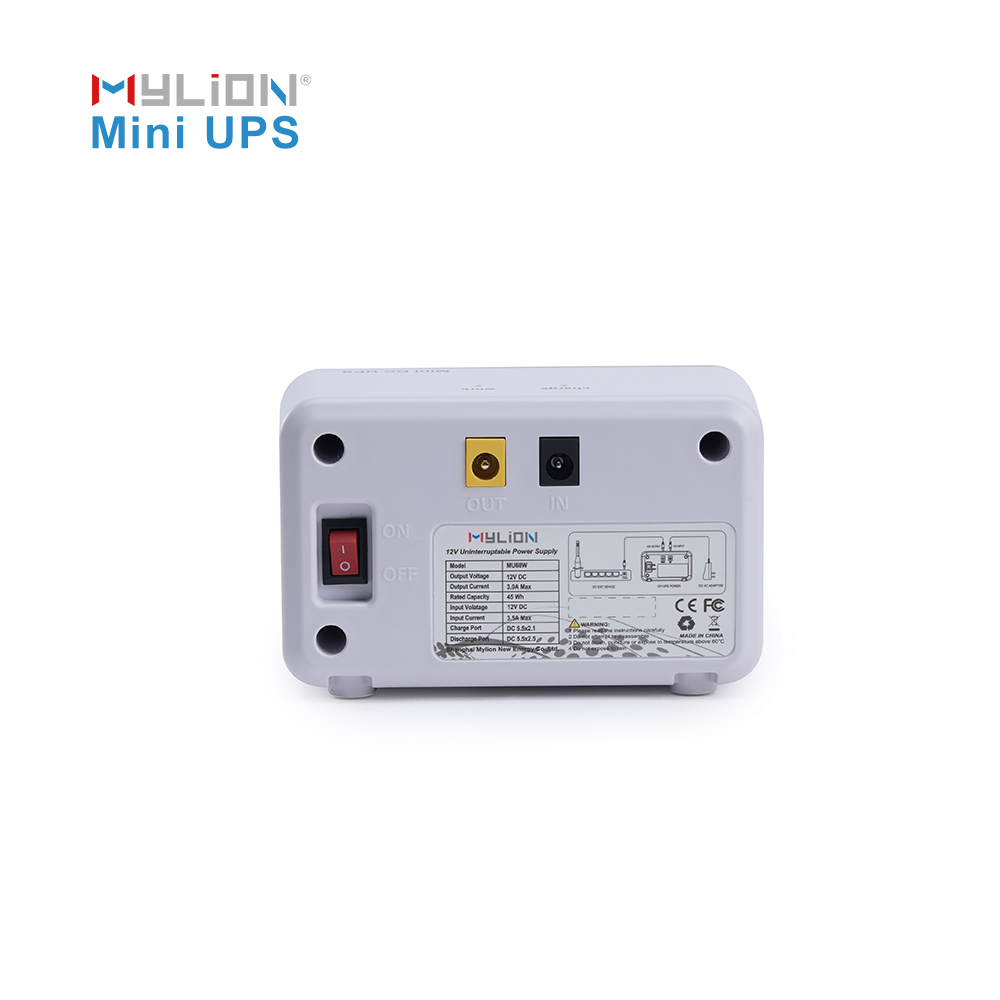
For standard ONT and router installations, the 12V Standard Series, including the MU26W, MU48W, and MU68W, provides 12V DC output at 2.5A continuous (3A maximum), with battery capacities ranging from 18.72Wh to 44.4Wh, suited to entry-level through mainstream broadband backup needs. The MU26W specifically supports a 12V DC input of up to 3.5A through a DC5521 input / DC5525 output interface, with 18.72Wh of battery energy.
Where longer backup duration is required, such as in residential or remote areas prone to extended outages, the 12V Long-Runtime Series (MU635W / MU635L) delivers the same 12V, 2.5A continuous output paired with 75.6Wh of battery energy.
For high-load CPE or gateways that exceed standard 2.5A thresholds, the 12V High-Power Series (MU65W) supports a 12V DC input of up to 6A and a 4A continuous output (5A maximum, 60W total), with 56.16Wh of battery energy. The 12V High-Power Long-Runtime Series (MU35W / MU35L) combines that same 60W output capability with an extended 75.6Wh battery for professional gateways requiring both high peak current and long backup time.
For installations where a single ONT and router must be powered from one AC outlet, the AC-Input Dual Output Series (ML1202AC) accepts 100–240V AC input and provides two independent 12V DC ports, 2A each with a 24W total system limit, using LiFePO4 battery chemistry and 25.6Wh of battery energy, removing the need for a separate external DC adapter.
For setups requiring simultaneous backup of a networking device and a USB-powered accessory, the 12V + USB Multi-Output Series (MUJ46 and MUJ435) adds dual 5V/3A USB-A and USB-C outputs alongside the 12V DC port, within an 18W total system limit. The MUJ46 offers 37.44Wh of battery energy and 1.5A continuous (2A maximum) 12V output, while the MUJ435 extends battery energy to 50.4Wh.
Mylion is also advancing development-stage directions, including the MUC85, a USB-C PD Mini UPS under project evaluation for WiFi 6/7 devices requiring USB-C Power Delivery (65W standard / 100W max input) with 92.16Wh of battery energy, and the MU248, a 24V/48V telecom backup direction under development for higher-voltage wireless CPE and radio bridge equipment, featuring LiFePO4 chemistry, 48V/60V DC input, independent 24V (3A) and 48V (1A) outputs, a 100W system limit, and 102.4Wh of battery energy.
Why Project Teams Work with Mylion for Backup Power Selection
Rather than offering a single product for every scenario, Mylion positions itself as a B2B backup power partner and OEM/ODM project partner for telecom, ISP, broadband, and security applications. The company’s approach centers on evaluating solutions based on real device voltage, working current, peak/startup behavior, and installation environment, followed by technical confirmation and connector/cable matching to reduce selection errors before deployment at scale.
This process is supported by service capabilities that include requirement analysis, model matching, sample testing support, connector/cable matching, private labeling, and documentation coordination, along with managed pilot evaluation and mass-production preparation for larger projects. Products are developed with compliance considerations in mind, including model-specific UN38.3 and MSDS certifications relevant to lithium battery transport and safety documentation.
Mylion’s platform compatibility extends across routers, ONTs, ONUs, modems, gateways, CPE devices, and security/CCTV equipment, subject to electrical verification against each device’s actual specifications, reinforcing the same selection discipline described above rather than assuming universal compatibility. The company serves telecom operators, ISPs, broadband network companies, fiber network operators, and system integrators globally, working with technology partners across network equipment and fiber network operations.
Conclusion
Choosing the right Mini UPS backup power solution for an ONT ultimately comes down to matching real electrical requirements, including voltage, current, peak behavior, connectors, and runtime needs, to a product built for that specific scenario. For telecom operators, ISPs, broadband network companies, fiber network operators, and system integrators seeking a structured, technically grounded approach to this selection process, Shanghai Mylion New Energy Co., Ltd. offers a Mini UPS portfolio and B2B project support model designed around exactly these evaluation criteria, supporting more reliable DC backup deployment while reducing avoidable selection risks for professional project customers.

Reviews
There are no reviews yet.