Description
Industry Background and the Problem of Unreliable Subscriber-Side Power
Telecom operators and Internet Service Providers face a recurring operational challenge: keeping subscriber-side network equipment online during unstable power conditions. Routers, ONTs, modems, gateways, CPE devices, and small communication terminals are frequently exposed to power interruptions, voltage fluctuations, and unexpected adapter disconnection. When these events occur, the affected devices reboot, and repeated reboots translate directly into service complaints, customer churn, and higher field maintenance costs for the operator.
This is not a marginal issue. As broadband and fiber networks extend into homes, small offices, and remote installations, the number of subscriber-side devices requiring backup power continues to grow, while the diversity of device voltage, current, and connector requirements makes generic backup power products increasingly unsuitable. Addressing this reliably requires more than off-the-shelf hardware; it requires engineering judgment grounded in real device behavior.
Shanghai Mylion New Energy Co., Ltd., operating under the brand MYLION, has built its position around this specific problem. With over 13 years of experience in lithium battery packs, Mini UPS, DC backup power, and customized battery solution development, MYLION approaches backup power as an engineering-driven B2B discipline rather than a retail commodity category, serving telecom operators, ISPs, broadband network companies, system integrators, distributors, and OEM/ODM project customers across Europe, North America, Australia, Latin America, Africa, the Middle East, and Asia.
Authoritative Analysis: Why Matching, Not Generic Supply, Determines Success
The core proposition behind MYLION’s approach is straightforward in logic but demanding in execution: help telecom operators, ISPs, and network equipment suppliers keep customer-side devices online during power failures by providing compact DC UPS and BBU solutions matched to real device voltage, current, connector, runtime, and safety requirements.
Necessity: Instead of selling generic UPS products, MYLION supports project-based model selection based on actual device power consumption, startup surge current, backup time target, installation environment, certification needs, labeling requirements, and mass production feasibility. This matters because a mismatched backup unit can fail exactly at the moment it is needed most.
Principle logic: MYLION’s battery system capability rests on lithium-ion and LiFePO4 battery packs protected by a Battery Management System (BMS) guarding against overcharge, over-discharge, overcurrent, short circuit, and abnormal operating conditions. Application matching is performed by evaluating real working current, startup surge, device voltage, connector type, runtime target, installation method, and safety margin before a model is confirmed.
Standard reference: Quality discipline includes incoming material control, production process inspection, functional testing, aging or charge/discharge verification when required, and 100% outgoing inspection before shipment. Certification support may include CE, FCC, RoHS, UN38.3, MSDS, and IEC 62368-related evaluation, though availability varies by product model and final configuration.
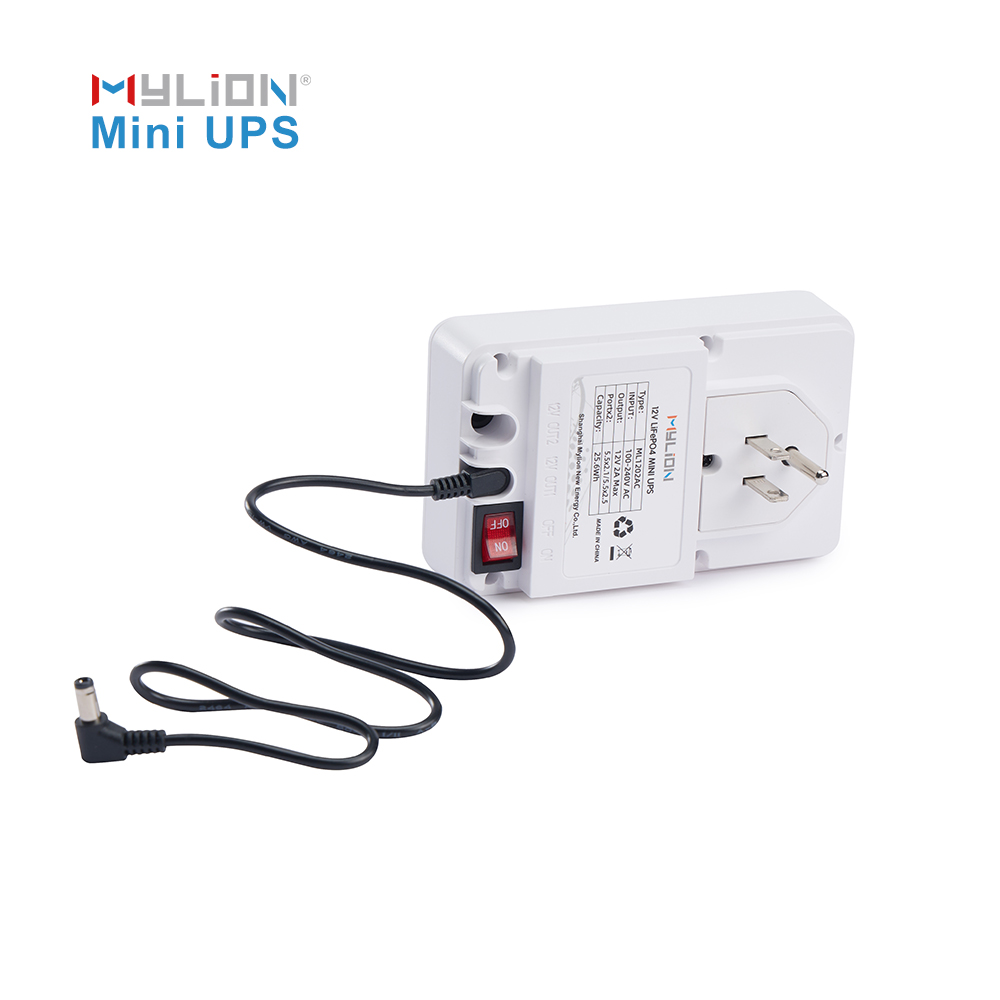
Solution path: The product matrix reflects this matching logic across categories: the 12V Standard Mini DC UPS Series (MU68, MU26, MU48) for mainstream routers, ONTs, modems, and gateways; the High-Power 12V Telecom BBU Series (MU35, MU65) for higher-load gateways and CPE; the Inline FTTH Mini UPS Series (MUJ46) for compact fiber terminal installations; the USB-C PD Mini UPS Series (MUC85) for devices using USB-C power architecture; the 24V / 48V DC Backup Power Series (MU248) for non-standard voltage equipment; and the LiFePO4 Mini UPS Series (ML1202AC) for customers prioritizing cycle life and thermal stability.
Deep Insights: Emerging Pressures on Backup Power Selection
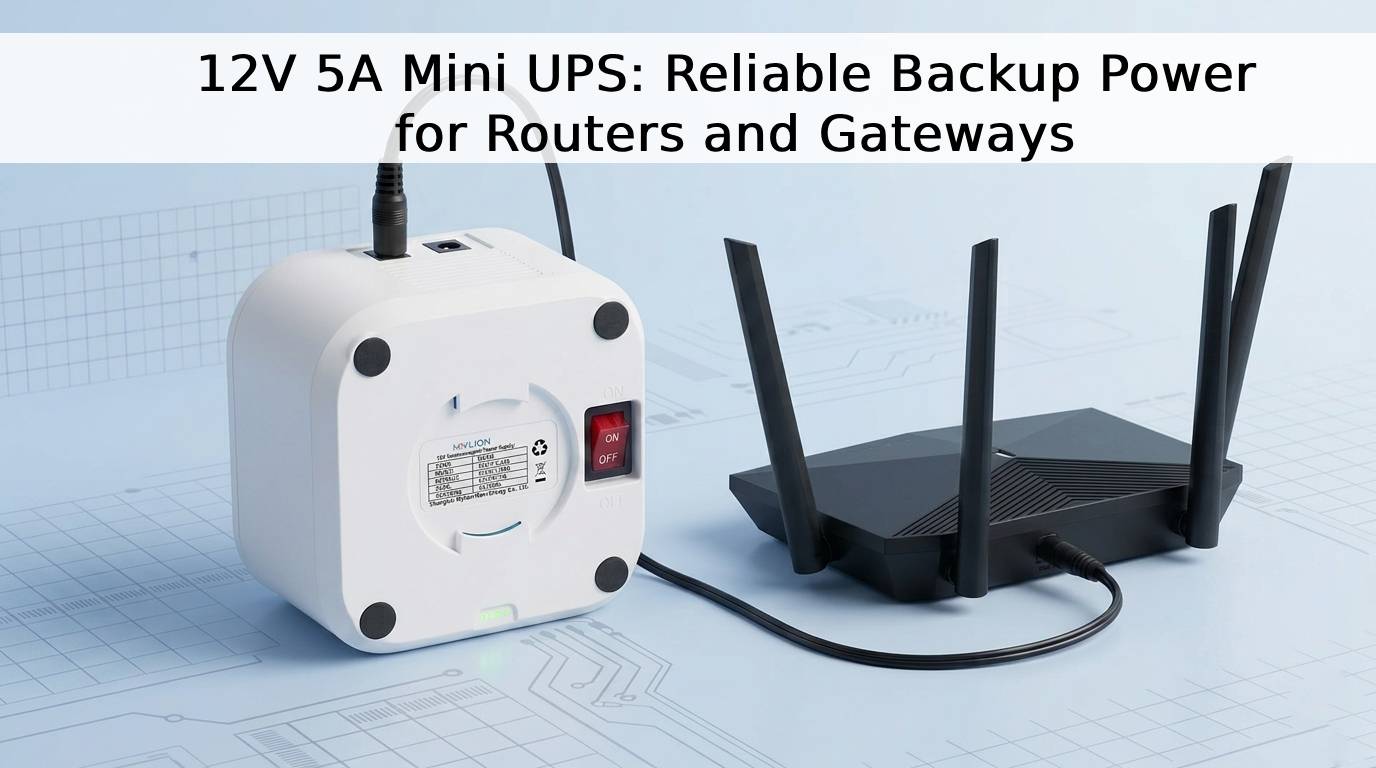
Several structural shifts are changing how backup power decisions should be made. First, more modern devices are moving from traditional DC barrel input toward USB-C Power Delivery architecture, meaning standard DC UPS products may no longer match these devices due to different voltage negotiation and connector requirements. Backup power suppliers who cannot support USB-C PD compatibility risk becoming irrelevant to newer device generations.
Second, higher-performance gateways and telecom devices increasingly demand more current than standard low-current Mini UPS models can support. A recurring risk identified in project experience is that customers select models by relying only on adapter label current instead of real device load, startup surge, or peak current. When the backup unit is under-rated, the device may shut down, restart, or fail during customer testing—an outcome that undermines confidence in an entire deployment before it scales.
Third, not all telecom and communication devices operate on standard 12V input. Some require 24V or 48V DC power, making ordinary Mini UPS products structurally unsuitable regardless of capacity. This pushes the industry toward more segmented, voltage-specific product lines rather than one-size-fits-all backup power.
Fourth, battery chemistry itself is a differentiating variable. LiFePO4 battery technology offers longer cycle life and improved thermal stability compared with standard lithium-ion systems, which is particularly relevant for applications requiring long-term standby use and repeated backup cycles.
Finally, certification and documentation remain a moving target rather than a fixed guarantee. Certification availability and scope may vary by product model, battery configuration, power adapter, and final label, meaning that for customized BBU or Mini UPS projects, certification requirements should be confirmed based on the approved product version rather than assumed in advance.
Company Value: Engineering Depth Applied to Real Deployment Conditions
MYLION’s value to the industry comes less from any single product and more from the consistency of its project methodology. The company has developed from a customized battery pack supplier into a focused B2B backup power solution provider for telecom, ISP, broadband, security, and industrial applications, continuing to expand its Mini DC UPS and BBU range for 5V, 9V, 12V, 15V, 24V, 48V, USB-C, PoE, and multi-output backup power applications.
In practice, this means MYLION supports customers through the full project lifecycle: requirement analysis, model selection, sample testing, technical confirmation, quotation, certification coordination, production, inspection, and shipment. For telecom and ISP projects specifically, this includes evaluating backup time, real device current, router/ONT/gateway compatibility, installation environment, safety requirements, and mass deployment feasibility.
Supply capability extends beyond engineering into logistics: MYLION provides engineering support, sample preparation, production coordination, quality inspection, export documentation, and international logistics support for global projects, alongside OEM/ODM services such as private labeling, customized packaging, connector matching, cable customization, and capacity adjustment.
Conclusion and Recommendations for Industry Decision-Makers
The evidence from MYLION’s project experience points to a clear operating principle: backup power selection for telecom and ISP applications should be driven by real device specifications, not by adapter labels or generic product assumptions. Decision-makers evaluating Mini DC UPS or telecom BBU solutions should confirm device voltage, actual working current, startup surge, connector type, required backup time, installation environment, and certification needs before committing to a model.
For system integrators, distributors, and OEM/ODM brand owners, the broader lesson is that backup power is not a commodity decision when it touches subscriber-facing infrastructure. Selecting a partner capable of project-based technical matching, sample testing, and consistent quality inspection—rather than one offering only standardized, low-cost hardware—reduces the risk of device failure during testing or field deployment. As device architectures diversify across USB-C PD, higher-voltage DC standards, and higher-current requirements, this matching discipline is likely to become more, not less, important for maintaining stable broadband and telecom service continuity.

Reviews
There are no reviews yet.